Review the packaging when the product changes, even if the pouch artwork and declared quantity remain familiar. Formulation, particle form, bulk, filling conditions or intended use can alter the questions the package must answer. Compare the old and proposed product briefs and ask the responsible technical owners which evidence remains applicable. The result may be a limited review or a new qualification need, depending on the actual difference.
Record the difference in the product
State what changed and why, distinguishing confirmed differences from expectations. A new flavour may be only a content change in one case and involve a relevant formulation difference in another. Smaller pieces may change the apparent fit at the same mass. A new intended storage condition may change the evidence question even when formulation is unchanged. Avoid declaring the effect before technical review. The buyer’s first task is to make the proposed product difference clear enough for the packaging and filling owners to assess it.
Trace the affected interfaces
Check product-to-material, product-to-opening, filling, final closure, presentation and distribution interfaces as relevant. Use the actual project record rather than a blanket assumption that all earlier approvals remain valid or all must be repeated. Ask each owner to state what evidence still applies and what needs review. Barrier evidence has its own scope, illustrated by separate OTR and WVTR methods; those measurements do not automatically answer every changed-product question. Keep the technical reasoning beside the decision.
Control the product-pack transition
Link the accepted product and packaging revisions in the item record. Identify which orders, stock and packing batches are affected by the change through the business’s established process. Do not assume visually identical old and new material can be substituted without review. If the packaging remains unchanged after assessment, record the basis for that decision. This is valuable evidence: a justified no-change decision is stronger than silence. If a new construction or geometry is needed, update the relevant artwork, filling and release references before normal supply.
Use a product-to-pack change review
The review connects the product proposal to the existing packaging evidence. It helps procurement ask focused questions without deciding formulation or material suitability independently.
| Record | What to capture and how to use it |
|---|---|
| Product baseline | Record the currently accepted product reference and intended use. Link the packaging configuration qualified for it, so reviewers can retrieve the actual starting point rather than a generic category description. |
| Proposed difference | Describe changed formulation, form, bulk, process or use conditions as applicable. Identify the source and missing information, preserving the distinction between a confirmed change and a predicted effect that still needs assessment. |
| Interface assessment | List potentially affected fit, contact, filling, closure and presentation requirements. Ask responsible owners to identify applicability, using the real product and route instead of assuming every new flavour or particle change has the same consequences. |
| Evidence decision | Record which existing evidence remains valid and what additional assessment is required, with reasoning. A justified decision to retain packaging should be recorded as explicitly as a decision to change it. |
| Transition reference | Link accepted product and packaging revisions to affected orders and stock status. Coordinate the release and identity plan through the established business process so production staff can distinguish the configurations actually authorised for use. |
Keep the completed review with the product change, not only in the packaging folder. Future product teams need to know the packaging evidence boundary when they propose another modification.
Illustrative same-weight, different form
A brand changes an illustrative dry product from larger pieces to a finer form while retaining the same declared mass. The buyer requests a fit and filling review and asks the material owner whether any other evidence needs reassessment. It does not assume that the old pouch will fail or that the same mass guarantees identical behaviour. The review records the actual changed form, relevant observations and accepted scope before the repeat packaging order is confirmed.
Establish the product baseline before comparing changes
Identify the product currently covered by the packaging evidence, including its formulation or relevant specification revision. Record the proposed difference in terms the technical team can assess. A new flavour name may describe a small commercial change or conceal a relevant formulation difference. The packaging reviewer needs the actual information rather than the marketing label alone.
Keep this review centred on the product change. Replacing a packaging component or changing a converting process is a different initiating task. Those changes can interact with the product assessment, but the first question here is which package requirements may be affected by the changed contents or their intended use.
Trace the changed product to its package interface
Ask whether the change could affect filling behaviour, available volume, closure-area contamination, product contact, barrier need or customer access. These are review prompts rather than predictions. The qualified product and packaging owners should decide which apply. Record the reason when a prompt is judged irrelevant, keeping the review proportionate to the real change.
For an illustrative dry mixture, adding a different particle size may change the filled shape or dose path even if the stated mass remains the same. A change in product sensitivity may raise a different evidence question. Do not treat either possibility as established without the product information and appropriate assessment.
Compare evidence with the changed condition
List the existing material reports, product-package assessments and relevant observations. For each, ask whether its specimen and conditions still represent the revised product. Choose retained with a reason, reassessment required or insufficient information. A previous successful order is useful history, but it does not identify which changed requirement remains covered.
AMETEK MOCON's whole-package paper distinguishes film screening from formed-package evidence. The relevant lesson is to identify the evidence level before applying it to a product decision. Its case results are not a substitute for reviewing the changed product and proposed pack under their own conditions.
Use the next sample to answer the changed question
If the concern is occupied volume, plan a representative filled-geometry observation. If it is a contact or product-quality concern, the technical owner should select the appropriate assessment. A new artwork sample alone cannot settle either. The specimen and procedure should follow the unresolved requirement rather than the easiest sample to obtain.
Record any difference between the revised product used in the assessment and the launch specification. A pilot formulation can be informative, but later adjustments may affect applicability. Keep the product reference linked to the sample identity so a favourable observation cannot be transferred silently to a different commercial formulation.
Work through an illustrative density consequence
Suppose a 100 g product changes from an illustrative bulk density of 0.25 g/mL to 0.20 g/mL. The simple bulk volumes are 400 mL and 500 mL respectively, calculated by mass divided by density. The increase is 100 mL. These invented values show why unchanged mass does not necessarily mean unchanged occupied volume.
They do not select a pouch size or establish headspace. Filling dynamics, product shape and closure clearance still require assessment. The useful next action is to check representative product in the proposed geometry and record the condition. Keep this calculation as a screening example, not a capacity guarantee.
Close with product-specific applicability
The review conclusion should name the revised product, proposed packaging baseline and accepted evidence. State the technical rationale for retained evidence and identify any remaining assessment. Procurement can then link the buying decision to a defined combination instead of assuming every variant uses the same approved package without review.
If the product changes again, return to this baseline and identify the new difference. Keep the review history concise enough to follow. Its value is that a modest commercial update receives the relevant technical attention without restarting unrelated work or inventing a universal rule that every flavour requires a new material. The decision follows the actual changed requirement and the evidence available.
Material change control: a practical specification example
Two samples have similar appearances but different material requirements. One may use a clear panel and another an opaque surface; neither appearance specifies its complete layer structure. Keep the product, storage conditions, fill method and required performance in the brief. Ask for the proposed construction in writing so the comparison remains meaningful when a paper-look or metallic appearance is introduced.
For this decision, start with the original and replacement construction. The useful output is the differences requiring a new sample or performance review. Put that output beside the relevant quotation, drawing or sample rather than leaving it in a separate email. This is an illustrative decision exercise, not a report of a completed customer trial.
Product references to make the discussion concrete
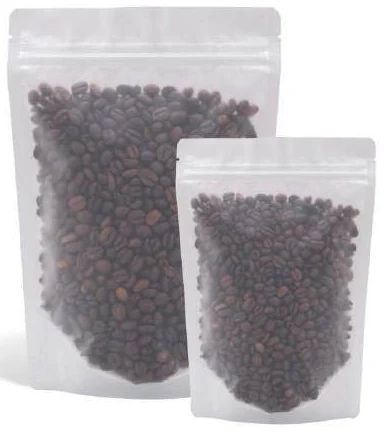
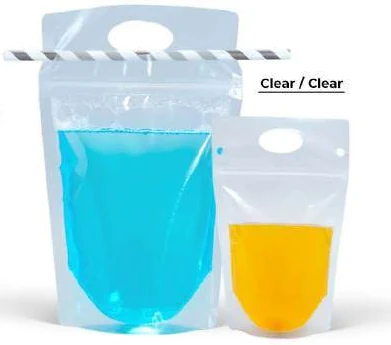
The catalogue includes clear-front opaque-back pouches and kraft paper pouches. These examples show different physical constructions; they are not interchangeable specifications. A clear front shows the contents while an opaque or metallic back provides a contrasting panel. Specify which face carries the principal artwork and check how it reads through the transparent face. The windowed side and opaque side need a coordinated material brief.
| Format reference | Material or construction to clarify | Details to include in the brief |
|---|---|---|
| Clear-front opaque-back pouches | Transparent front paired with opaque or foil-look back panels; confirm the layer construction on each face. | Front and back material requirements; artwork side and orientation. |
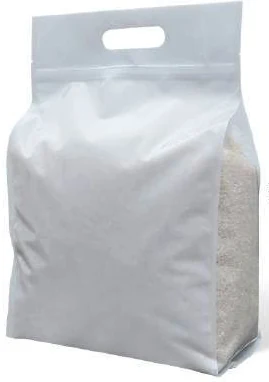
| Kraft paper pouches | Kraft or paper outer with a product-specific inner construction; paper appearance does not establish a plastic-free composition. | Paper colour and surface preference; full layer structure and thickness. |
Use the reference pictures to identify the base, side panels, window or opening that you mean. A picture cannot supply the missing dimensions or material layers. If a photograph shows a finish or closure you do not want, state that difference explicitly; otherwise a visual reference can introduce an unintended requirement.
Complete the record before requesting the next sample
- Attach the differences requiring a new sample or performance review. Identify the product or SKU and the date of the observation.
- Record the original and replacement construction. Keep confirmed information separate from proposed values and questions for the supplier.
- Add the actual fill weight or volume, the dimension convention, material proposal and intended closure. Include the number of designs and quantity per design when requesting a quotation.
- State which question the next drawing, sample or quotation must resolve. A change of size, closure or material should remain visible alongside the earlier reference.
This record makes the next conversation specific. It lets the design, purchasing and packing teams work from the same proposed item and shows which decision still needs evidence. Review the related product pages for format details, or prepare a custom packaging brief with the unresolved requirements.
Carry the decision into ordering
Reference the accepted product-pack combination in repeat orders and line documentation. Ask suppliers and co-packers to identify assumptions before supply or filling. Reopen only the affected requirements when another change occurs, preserving the rationale. This keeps product development and packaging procurement connected without turning every alteration into an unstructured restart.
Send the completed product-to-pack change review with your product and filling details to Navkar Poly Print for a project-specific discussion. Ask for the proposed specification, evidence required and open questions to be recorded before quotation approval.
Sources and scope.
These references support the technical discussion. Product photographs illustrate formats; the material, dimensions and suitability of the proposed pack are confirmed for each project.
- ASTM F3136 oxygen gas transmission rate
Standards-owner scope for one OTR method; not a requirement that this method applies to every project.
- ASTM F1249 water vapour transmission rate
Standards-owner method scope, distinct from an application-specific acceptance limit.
- Shelf Life and the Importance of Testing the Whole Package
Method-level distinction between flat film and formed package evidence; no case outcome transferred to changed product.
Let’s discuss your product.
Share your contents, dimensions, filling method, quantity and delivery destination. We’ll work through the proposed packaging specification with you.
Create a packaging brief