Request compatibility review against the actual product and intended use conditions. A category name such as sauce, hair oil or powder is not a complete formulation or process brief. Ask the qualified product and packaging teams what information and evidence are needed for the proposed construction and closure. Procurement can coordinate that record without selecting a universal film recipe or making a safety or suitability assurance.
Collect the useful product brief
Record product form, relevant formulation information available for review and proposed filling, storage and use conditions. Identify confidential information that needs an agreed technical exchange route. Do not guess missing chemistry from the retail product name or assume another brand’s pack is transferable. Ask the qualified owner what information is essential at each stage. A preliminary enquiry can remain useful when it states what is known and what must be supplied before technical acceptance, instead of presenting an incomplete brief as a finished material specification.
Identify the complete proposed package
Record construction, relevant contact surfaces, fitments, closures and feature positions. Ask how supplied evidence maps to that complete proposal. A film document alone may leave a component interface or intended process condition unassessed. Bostik describes laminate systems, illustrating why a shorthand film name is incomplete. Do not infer retort, aseptic, hot-fill or chemical suitability from a familiar pouch shape. Those applications require their own exact technical basis and cannot be confirmed by this general buyer workflow.
Scope the evidence and decision
The responsible team should choose suitable assessment methods, representative specimens and acceptance requirements. Record the plan and resulting scope without inventing sample sizes, exposure periods or pass thresholds. Keep product-contact regulatory review distinct from observed functional compatibility. For Indian food applications, the FSSAI compendium is an official review reference, while current applicability must be checked by qualified reviewers. A product trial, document or component statement should be accepted only for the conditions it actually covers.
Use a compatibility scope register
The register coordinates the technical discussion and evidence. It is a procurement tool, not a test protocol or a declaration that the proposed system is suitable.
| Record | What to capture and how to use it |
|---|---|
| Product information | Record the actual product and relevant formulation details available to the qualified reviewer. Identify confidential or missing information and its agreed exchange owner, avoiding assumptions based solely on a broad product-category name. |
| Use conditions | State proposed filling, storage and customer-use conditions with confirmed and provisional entries distinguished. Ask the technical owner what further conditions matter before a supplier is asked to provide an unrestricted suitability assurance. |
| Package system | Identify the construction, contact faces, closures and components proposed. Link their references and evidence, keeping any unassessed component interface visible rather than treating a film report as approval of the assembled package. |
| Assessment plan | Record the qualified team's chosen evidence, representative specimens and acceptance basis. Preserve the plan's limits and responsible owners without substituting generic test durations or thresholds taken from another product. |
| Decision boundary | Record accepted conditions, unresolved questions and change triggers. Keep regulatory-contact and functional decisions distinct, and require applicability review when formulation, process, construction or component references change. |
Use clear status words such as proposal, under assessment and accepted within stated scope. They make a technical discussion more honest than a general suitable flag that conceals incomplete product information.
Illustrative incomplete liquid enquiry
A buyer asks for a standard pouch for a liquid but has not supplied the proposed filling condition or enough formulation information for review. The supplier can discuss format options, while the scope register keeps compatibility unassessed. The buyer arranges the relevant technical information exchange and asks for a scoped proposal. The example does not state that the product is unsafe or unsuitable; it identifies the information needed before anyone can responsibly accept the actual system.
Describe the actual product to the technical reviewer
A category such as food, detergent or powder can contain products with very different formulations and behaviour. Provide the information the qualified reviewer requests, through an appropriate confidential channel where necessary. Record the product identity and revision. If the formulation is provisional, say so rather than treating a category name as a complete compatibility brief.
Include relevant physical characteristics such as flow, particles or contact with specific components. The technical reviewer should decide what chemical or other detail is needed. Procurement should not guess missing formulation information or promise suitability based on a competitor's pack. A familiar market example can suggest a question, but it cannot approve the proposed product-package combination.
Define the conditions throughout use
Record proposed filling, storage, distribution and customer use conditions. Include whether the package is intended for repeated access and which surfaces the product may contact. A construction assessed for one condition may need review for another. Do not infer hot-fill, retort, aseptic or other specialised suitability from the pouch format or a supplier's broad application list.
For food applications, use the FSSAI official regulations index as a starting point for qualified Indian review. This does not make a regulatory document a complete compatibility study. Contact suitability, physical performance and product-quality questions may require different evidence linked to the same intended use.
Include every relevant part of the package system
List the film construction, closures, fitments and other components in the proposed system. Identify which part each supplier provides and which operation assembles or closes it. A report for the body film may leave another product-contact interface unresolved. Ask the technical owner to map the evidence rather than treating the package as one unnamed material.
Keep the current references together. If a component is replaced later, its effect on the compatibility review should be assessed against the intended product and conditions. Similar appearance or a shared component category does not establish identical evidence coverage. The record should support a focused question about the changed interface.
Ask for an assessment plan with observable outcomes
The qualified team should define the relevant method, specimens, conditions and acceptance basis. Procurement can ask for a clear plan without inventing test parameters. Record what outcome each assessment is intended to address, such as a specified product-quality concern or package function. Avoid a broad request to “test everything” that leaves no decision criterion.
If a trial sample differs from the intended order, state the difference before interpreting results. A substitute product may help a handling demonstration but cannot automatically answer formulation compatibility. An unprinted geometry sample can answer access questions while leaving the final construction to another review. Keep those useful conclusions narrow and traceable.
Investigate an observation without assuming its cause
Suppose an illustrative retained pack develops an unexpected odour. Record the sample identity, product, storage condition, timing and observation method. Keep the relevant comparison references through the organisation's procedure. Do not immediately attribute the odour to the film, ink, product or filling environment without an appropriate investigation.
Ask the technical owner which evidence can distinguish plausible explanations. The next action may involve supplier information, product assessment or another defined test. A single observation is a reason to investigate; it is not a basis for a public safety claim or a universal statement about the material family.
Close the assessment for a defined combination
The decision should identify the product, package construction, components and conditions covered. Link the accepted evidence and state any remaining limitation. A positive result should not become a claim of suitability for all products in the category or every process temperature. Keep the actual scope visible in the enquiry and release record.
Revisit the assessment when formulation, component, filling condition or intended use changes. The existing evidence may remain partly applicable, but the technical owner should explain why. The completed compatibility brief gives procurement a disciplined way to collect and route information while preserving responsibility for the actual scientific and regulatory judgement.
Product compatibility: a practical specification example
Two samples have similar appearances but different material requirements. One may use a clear panel and another an opaque surface; neither appearance specifies its complete layer structure. Keep the product, storage conditions, fill method and required performance in the brief. Ask for the proposed construction in writing so the comparison remains meaningful when a paper-look or metallic appearance is introduced.
For this decision, start with the actual formulation and contact conditions. The useful output is an agreed compatibility review tied to the proposed materials. Put that output beside the relevant quotation, drawing or sample rather than leaving it in a separate email. This is an illustrative decision exercise, not a report of a completed customer trial.
Product references to make the discussion concrete
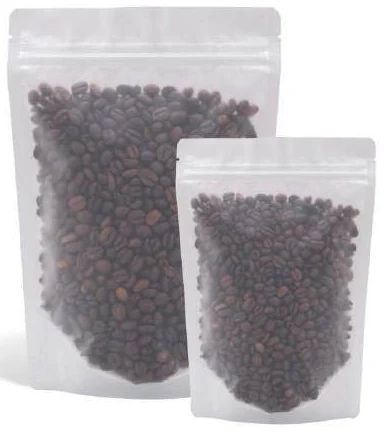
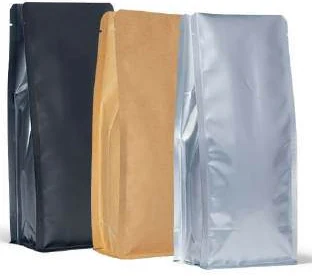
The catalogue includes clear-front opaque-back pouches and kraft paper pouches. These examples show different physical constructions; they are not interchangeable specifications. A clear front shows the contents while an opaque or metallic back provides a contrasting panel. Specify which face carries the principal artwork and check how it reads through the transparent face. The windowed side and opaque side need a coordinated material brief.
| Format reference | Material or construction to clarify | Details to include in the brief |
|---|---|---|
| Clear-front opaque-back pouches | Transparent front paired with opaque or foil-look back panels; confirm the layer construction on each face. | Front and back material requirements; artwork side and orientation. |
| Kraft paper pouches | Kraft or paper outer with a product-specific inner construction; paper appearance does not establish a plastic-free composition. | Paper colour and surface preference; full layer structure and thickness. |
Use the reference pictures to identify the base, side panels, window or opening that you mean. A picture cannot supply the missing dimensions or material layers. If a photograph shows a finish or closure you do not want, state that difference explicitly; otherwise a visual reference can introduce an unintended requirement.
Complete the record before requesting the next sample
- Attach an agreed compatibility review tied to the proposed materials. Identify the product or SKU and the date of the observation.
- Record the actual formulation and contact conditions. Keep confirmed information separate from proposed values and questions for the supplier.
- Add the actual fill weight or volume, the dimension convention, material proposal and intended closure. Include the number of designs and quantity per design when requesting a quotation.
- State which question the next drawing, sample or quotation must resolve. A change of size, closure or material should remain visible alongside the earlier reference.
This record makes the next conversation specific. It lets the design, purchasing and packing teams work from the same proposed item and shows which decision still needs evidence. Review the related product pages for format details, or prepare a custom packaging brief with the unresolved requirements.

Request a scoped technical proposal
Send the register with the available product and packing brief, asking the supplier to identify evidence and open conditions. Record the qualified decision before making application claims. Keep the accepted package references together for repeat orders and reassess affected scope after changes. This gives procurement a concrete next step while leaving technical assessment with the appropriate specialists.
Send the completed compatibility scope register with your product and filling details to Navkar Poly Print for a project-specific discussion. Ask for the proposed specification, evidence required and open questions to be recorded before quotation approval.
Sources and scope.
These references support the technical discussion. Product photographs illustrate formats; the material, dimensions and suitability of the proposed pack are confirmed for each project.
- Bostik laminate adhesives
Adhesive manufacturer context for flexible lamination; suitability and process conditions remain project-specific.
- FSSAI packaging regulations compendium, version V
Official regulatory reference for a qualified reviewer to check; no compliance determination or certificate claim.
- FSSAI regulations index
Official starting point for qualified current Indian food-contact regulatory review; no company approval or compliance conclusion.
Let’s discuss your product.
Share your contents, dimensions, filling method, quantity and delivery destination. We’ll work through the proposed packaging specification with you.
Create a packaging brief