A family dry fruit pouch needs useful access throughout its intended use, not only an attractive full-pack appearance. Observe the actual product through first opening, normal serving and reclosure at defined remaining quantities. Whole pieces, mixtures and clustered fruit can create different tasks within the same nominal pouch size.
State the family-pack use proposition
Record the product, sale quantity and expected product-removal method. Identify whether the pack is intended for direct repeated use or transfer into another container. If the product owner expects customers to reclose it, state that task explicitly and identify the proposed feature.
Fresh-Lock's applications resource distinguishes reclosure-system types. The actual system and position need to be identified in the project drawing. A generic zipper icon does not show the remaining grip after first opening or the access available to a scoop.
Define the ordinary household sequence
Write the intended sequence before selecting features. Identify the opening action, serving method, reclosure and storage arrangement. State whether the user pours, takes individual pieces or uses an ordinary utensil. A family pack should support that actual sequence across its changing fill states.
Keep product identity and quantity controlled in the demonstration. Whole nuts, mixed dried fruit and cut pieces may create different access observations. If one component is intended for several products, record each application separately rather than using the easiest product as a proxy.
Specify which fill states the team intends to observe. Full, roughly half used and near the last serving can be useful descriptions when their actual quantities are recorded. They are scenario choices, not universal test stages. Let product and design owners choose the meaningful points for the intended use.
Use ordinary conditions approved by the product owner. Avoid adjusting the product to make the closure demonstration easier unless that action belongs in the intended customer instruction. The goal is to understand a plausible use task with an identified sample, not to produce the tidiest possible photograph.
Start with the unopened complete sample
Observe the first-opening cue and resulting mouth. Then perform the ordinary serving task using representative product and any actual tool. Record product contact near the feature, access to large pieces and ease of supporting the pouch. Avoid arranging the contents to make the demonstration easier than routine use.
Use the product owner's normal handling procedure. A convenience review should not invent storage or hygiene instructions. If a product requires particular conditions during testing, the responsible team must define them and assess their relevance to the final application.
Observe what remains after first opening
Begin with a received-state complete pack. Ask the observer to follow the intended opening cue, then record the resulting access and grip. A clean empty zipper demonstration omits the opening edge, full-product position and pouch shape that the customer actually encounters.
Describe interruptions precisely. The user may need another grip, a second opening attempt or clearer access to the feature. Those are actionable observations. A general judgement such as easy to use hides the part of the sequence that succeeded or failed.
Separate observation from coaching. If an explanation is provided, note it and distinguish the action before and after instruction. A design team can then decide whether the pack communicates the task or depends on additional wording.
For an illustrative comparison, two candidates may both permit first opening, while one leaves a narrower usable mouth for the intended utensil. That result concerns this product and task. It does not establish a universally better closure type or justify assigning an opening-force limit without a suitable technical assessment.
Use a remaining-product task ladder
| State | Task | Question |
|---|---|---|
| Full unopened | First opening | Is the path clear and usable? |
| First serving | Normal removal | Does product pass or remain accessible? |
| Partly used | Hold, serve and reclose | Does the changing shape affect operation? |
| Near empty | Remove remaining pieces | Are folds or corners obstructive? |
| Reclosed for storage | Ordinary placement | Does the pack match the stated use task? |
This original ladder uses defined product amounts selected for the actual proposition. It does not prescribe a universal number of servings or imply a validated storage period.
Follow access as the product level falls
At each planned remaining-product state, record the actual quantity, pouch shape and ordinary removal action. Keep the same scenario and receiver where appropriate so differences are interpretable. A pouch can become easier to grip while product becomes harder to reach.
Observe where the last material collects. Whole pieces may remain at a fold, while a mixture may leave smaller components in a different region. Describe the actual event rather than assuming every dry-fruit product behaves alike.
An original access record can include the action, interruption and proposed question. If a user tilts the pouch further to reach remaining product, ask whether the resulting transfer remains manageable. If they insert a utensil deeply, examine whether the intended mouth and grip support that ordinary task.
Include naturally occurring product near the reclosure feature after serving. Do not clear it silently before demonstrating closure. Record any instruction or action needed and let the relevant owners assess whether it belongs in the customer proposition. This connects the closure decision to the actual product-removal sequence.
Record product-specific access issues
For whole nuts, observe piece access and handling. For mixed dry fruit, record whether normal removal changes the visible component balance. For dates or other clustered products, record actual clustering and wall contact without assuming every batch behaves identically.
The Almond Board resource shows that product processing state matters. Keep the finished-product identity in the trial so a later roasted, coated or mixed version does not silently inherit an unrelated use or technical approval.
Convert the observation into a design brief
Write requirements in terms of tasks before prescribing a geometry. The brief might require access for the intended utensil at a defined remaining quantity, or a reclosure feature reachable with the observed pouch shape. The supplier can then explain candidate arrangements and their trade-offs.
Avoid translating every interruption into a larger component. More height may worsen reach to the last serving, while more width may change display and carton fit. A useful proposal considers the affected sequence rather than changing dimensions without a stated mechanism.
Keep technical product requirements beside the use proposition, with their own evidence references. Successful repeated access does not establish storage duration. A product study does not establish comfortable operation. Each relevant owner should approve the question their evidence actually addresses.
An illustrative decision could retain a candidate after defined access and reclosure observations, while asking for one changed mouth arrangement before final artwork release. Record why the candidate advances and which task remains open. That is more informative than an unqualified statement that the family pouch is approved.
Convert findings into functional requirements
An illustrative finding is a zipper that works on the full pack but becomes difficult to align after the front collapses at a lower product amount. The requirement should describe usable reclosure in that state. Do not assume a stronger component alone resolves a grip or geometry problem.
Record observations separately from preferences. A reviewer may like a taller pack visually while finding a shorter access path easier for the product. The product owner should decide the tradeoff using the actual task, supported by sample references and clear approval scope.
Preserve the scenario for future changes
Link the product reference, quantity, drawing, feature arrangement and scenario record. Include the actual remaining-product states and any instruction used. A future reviewer should be able to understand the observed sequence without relying on the original demonstration team.
If the product quantity changes, review whether the fill states and reach remain representative. If the product form changes, reconsider removal and material near the feature. If only artwork changes, check whether the opening cue or instruction is affected. Keep the impact review proportional to the actual change.
Retain both supported findings and unresolved limits. A particular storage orientation may have been observed while another was outside the scenario. Record that scope once so the approved proposition remains clear.
Before purchasing, reconcile the approved use reference with the quotation and drawing. Development samples can differ from the production proposal. Identify those differences and repeat affected tasks where required. Procurement then orders a defined component supporting an identified family-use proposition, with the product's storage and technical suitability retained under their separate accountable evidence.
Family dry-fruit zipper: a practical specification example
A dry-fruit range includes almonds, raisins and a gift assortment. Equal weights may occupy different volumes and present differently behind a window. Compare each product at its own intended fill rather than copying one size across the range. For a zipper pouch, review access and reclosure after repeated portions; for a gift pack, review how the filled pouch sits inside the outer presentation.
For this decision, start with the expected number of portions. The useful output is reclosure and access observed as the fill level falls. Put that output beside the relevant quotation, drawing or sample rather than leaving it in a separate email. This is an illustrative decision exercise, not a report of a completed customer trial.
Product references to make the discussion concrete
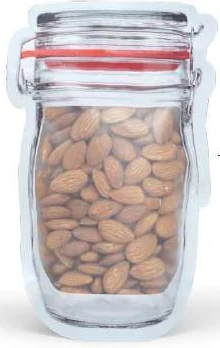
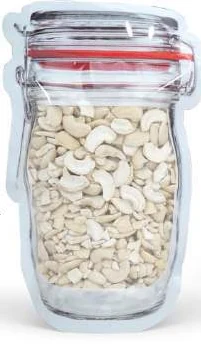
The catalogue includes jar-shaped zipper pouches and window pouches. These examples show different physical constructions; they are not interchangeable specifications. A contoured outline gives the pouch a jar-like silhouette while retaining a flexible pack construction. The narrow shoulder and top opening affect filling and access. Review the usable cavity, zipper length and artwork boundaries on a dimensioned drawing before committing to the shape.
| Format reference | Material or construction to clarify | Details to include in the brief |
|---|---|---|
| Jar-shaped zipper pouches | Clear or frosted flexible pouch construction with a zipper; the jar shape is a profile, not a rigid container. | Usable cavity and narrowest opening; die-cut outline and corner radii. |
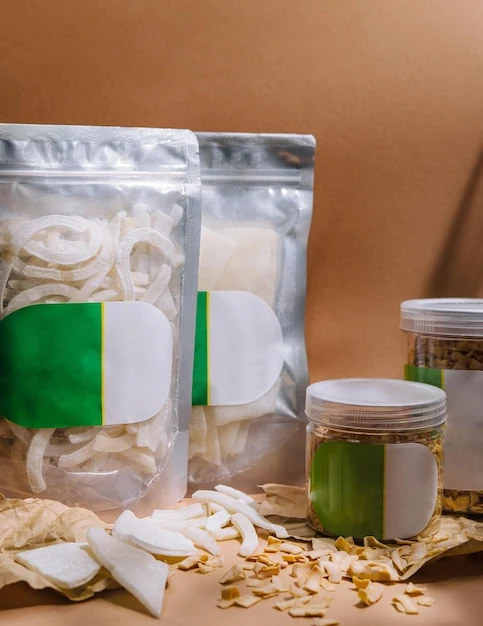
| Window pouches | A transparent window combined with paper-look or opaque flexible panels; confirm the full structure and product requirements. | Window width, height and location; product visibility at full and low fill. |
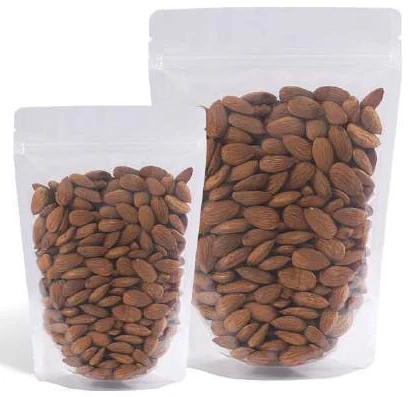
Use the reference pictures to identify the base, side panels, window or opening that you mean. A picture cannot supply the missing dimensions or material layers. If a photograph shows a finish or closure you do not want, state that difference explicitly; otherwise a visual reference can introduce an unintended requirement.
Complete the record before requesting the next sample
- Attach reclosure and access observed as the fill level falls. Identify the product or SKU and the date of the observation.
- Record the expected number of portions. Keep confirmed information separate from proposed values and questions for the supplier.
- Add the actual fill weight or volume, the dimension convention, material proposal and intended closure. Include the number of designs and quantity per design when requesting a quotation.
- State which question the next drawing, sample or quotation must resolve. A change of size, closure or material should remain visible alongside the earlier reference.
This record makes the next conversation specific. It lets the design, purchasing and packing teams work from the same proposed item and shows which decision still needs evidence. Review the related product pages for format details, or prepare a custom packaging brief with the unresolved requirements.
Release a complete use reference
Link product, drawing, opening arrangement, feature identity and ladder observations. Keep technical material suitability, complete closure performance and storage-life evidence under separate review. A successful short use demonstration does not establish those outcomes.
Send Navkar Poly Print the remaining-product ladder, product brief and ordinary removal method. Request samples that resolve the observed access or reclosure issue, then repeat the affected tasks on the actual proposed construction before final approval.
Sources and scope.
These references support the technical discussion. Product photographs illustrate formats; the material, dimensions and suitability of the proposed pack are confirmed for each project.
- Fresh-Lock flexible packaging closure applications
Differentiates press-to-close zippers and slider closure systems; not a performance claim for an unspecified pouch.
- Almond Board of California: moisture migration and management
Almond behaviour depends on processing state and environment; no shelf-life duration inferred.
Let’s discuss your product.
Share your contents, dimensions, filling method, quantity and delivery destination. We’ll work through the proposed packaging specification with you.
Create a packaging brief