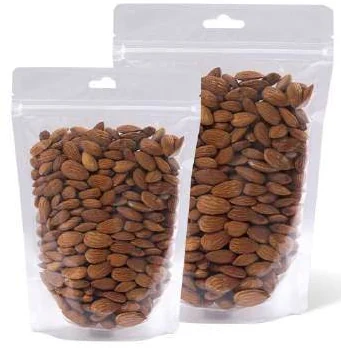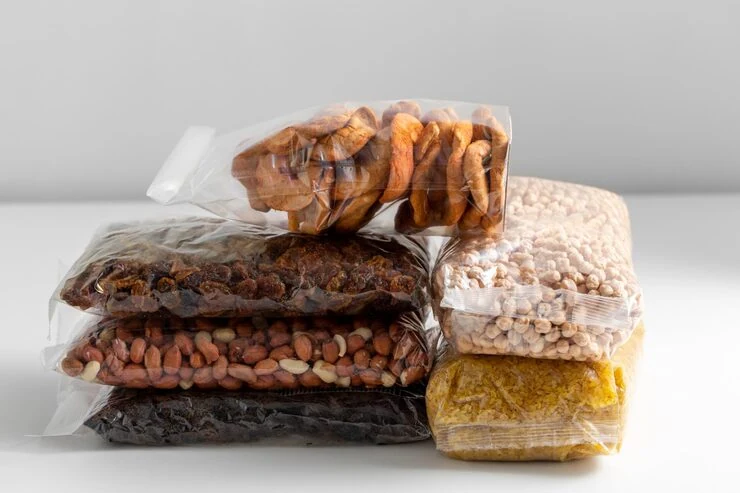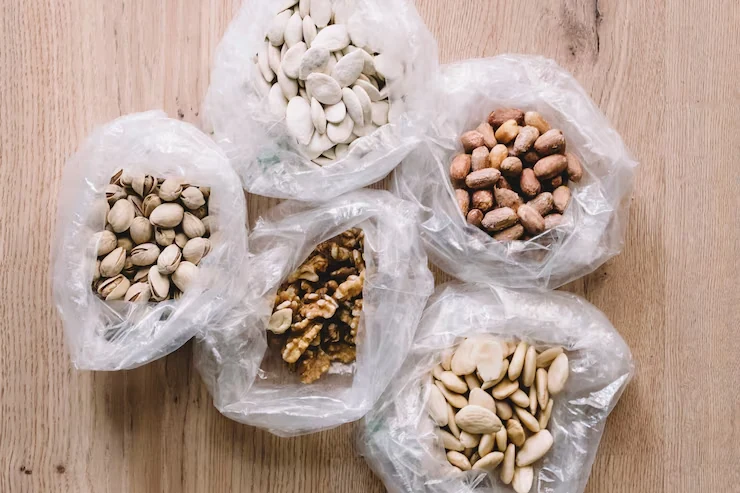
Specify a whole-nut pouch using the actual nut, processing state, piece range and intended quantity. Almonds, cashews and other nuts should not inherit one size or material prescription merely because they share a retail category. Approve physical fit and customer access on representative finished-product samples.
Describe the product that reaches packing
Record the actual finished-product reference, including processing or coating relevant to the enquiry. State the normal piece range and whether broken pieces are an intended part of the product specification. Use representative product, not only the largest or most attractive pieces selected for an image.
The Almond Board's moisture-management resource distinguishes behaviour by processing state. The practical action is to identify the actual product before discussing evidence. Do not transfer an observation about one nut form into a storage promise for another.
Keep processing form in the physical reference
Describe whole kernels, shelled or in-shell product, roasting state and any coating using the product owner's current specification. These details help distinguish physically different applications that may share a commercial nut name. Include the ordinary piece range and any permitted fragments rather than presenting a hand-picked sample of identical kernels.
Lin and colleagues' almond storage study compared natural whole, blanched whole and sliced forms under ten temperature-and-humidity combinations. The reported quality measures responded differently across forms and conditions. The abstract does not prescribe a pouch, but it supports retaining product form in the evidence record.
If one proposed pouch will serve several nuts, give each product its own reference and fit observation. Shared declared mass does not establish equal occupied space or access. A common component can be a useful commercial objective, provided the actual products support it.
Record the sampling rationale. A product owner may identify a normal range or a particular physical condition that needs examination. Keep that choice visible so a sample trial does not quietly become a promise about every future grade or supplier.
Screen fit without forcing the product
Record the space occupied by the intended quantity under a repeatable filling condition. Use that information to request candidate sample sizes. Fill each normally and observe the mouth, product region and clear closing area. A pouch that holds the mass only after careful piece arrangement may not suit the intended process.
Check product condition before and after the defined task using the product owner's method. Avoid inventing a universal breakage limit. If damage appears, locate the stage before attributing it to the pouch. Keep any investigation sample linked to the product and component identities.
Separate capacity from comfortable entry
First observe the intended quantity in a consistent volume-screening method. Then fill the dimensioned pouch candidate through the intended route. The container observation helps choose a sample range; the pouch trial shows entry, working space and filled shape.
Watch individual large pieces at the mouth rather than judging only the final mass. If a piece bridges the opening or needs deliberate placement, record that action. A successful manually arranged sample may leave the ordinary filling task unresolved.
An illustrative comparison could use equal 100 g portions of two whole-nut products. Product A enters candidate X without adjustment, while product B repeatedly needs a piece repositioned at the mouth. These invented observations identify an access difference; they do not establish that one nut universally requires a wider pouch.
Keep the final closing region in the assessment. A candidate may admit the product comfortably but leave little working space at the intended quantity. Record the actual position immediately before closing, with the product and sample reference. This gives the supplier a more useful problem statement than a general request for extra capacity.
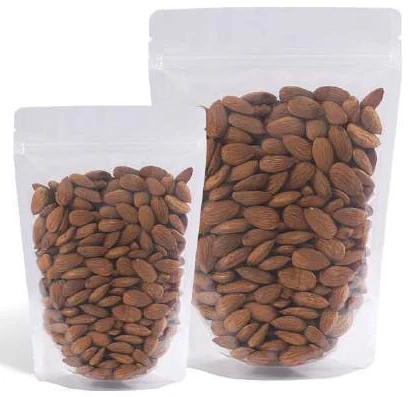
Use a whole-nut fit worksheet
| Review item | Record | Decision |
|---|---|---|
| Product form | Nut, processing state and piece range | Representative sample confirmed |
| Quantity | Intended net mass | Trial amount defined |
| Filling | Access, movement and closing clearance | Component fit assessed |
| Product condition | Before-and-after observation | Product owner acceptance |
| Customer use | Pour, scoop or individual removal | Opening requirement assessed |
| Outer packing | Filled arrangement and contact | Delivery configuration identified |
This original worksheet links product form to tasks rather than suggesting that a nut name determines a pouch. Include a separate row for each materially different finished form sharing the proposed component.
Review sample labels at the handover. An empty pouch, manually filled mock-up and observed production sample have different evidential roles. Identify each and retain the product and drawing references. If a sample was deliberately arranged for photography, say so in the internal record. This prevents a presentation aid from becoming an apparent filling approval and helps the next reviewer choose the correct sample when investigating a particular access or capacity question.
Assess access after first opening
Observe the complete unopened pack through the intended opening and product-removal task. Whole pieces may require a different access pattern from chopped product. If a zipper is specified, check remaining grip and reclosure after ordinary removal, not only on a clean empty pouch.
Record partly used handling if it belongs to the product proposition. A family pack can change shape as product is removed. State whether standing after opening is required or merely preferred, and review the relevant condition physically rather than assuming a full-pack photograph covers it.
Observe access with the real removal task
State whether the customer pours, reaches into the pouch or uses a utensil. Begin with the complete unopened pack and the intended opening cue. After opening, inspect the remaining mouth and ordinary grip before removing the contents.
For whole nuts, review whether large pieces pass through the usable opening without deliberate rearrangement. The opened access is not necessarily the same as the empty component's full mouth. The opening path and remaining material can change what the user can reach.
Include a naturally partly used condition if repeated access belongs to the product proposition. Record product location and pouch shape. A low-fill pouch can require a different grip or reach, so a full-pack photograph does not cover the complete use sequence.
If product remains in a fold, describe the location and ordinary action needed to remove it. Ask the product owner whether that action is acceptable. The solution might involve mouth arrangement, geometry or the serving proposition. Increasing every outside dimension without identifying the task can create unnecessary changes to display and carton arrangements.
Keep quality evidence tied to the product
UC Davis's walnut guidance treats handling and storage as parts of quality. Your procurement brief should therefore include actual storage and distribution conditions supplied by the product owner. A successful filling trial does not establish a shelf-life duration or formulation suitability.
Ask the technical team what material and complete-pack evidence is needed. Keep any proposed performance claim pending until its scope is supported. The familiar appearance of a nut pouch is not a substitute for the actual product's approval record.
Decide when a shared pouch is justified
Make a product-by-task comparison for any proposed common component. Put the actual products in rows and entry, closing space, opening, removal and outer-pack arrangement in columns. Reference the sample observations instead of relying on a single overall statement that the pouch fits.
An illustrative outcome could retain one component for two whole-nut SKUs while a third needs further access work. Record the evidence for each combination. Sharing artwork dimensions or order quantities does not close the third product's unresolved task.
Keep commercial benefits as actual business inputs. A common component may simplify purchasing, but its value depends on quotations, quantities and operational consequences. Avoid claiming lower cost before those details are known.
At release, pair each approved product reference with the approved drawing and construction. Keep any conditional combination clearly identified in the internal order control. When the product form or grade changes, use this matrix to locate the affected tasks and decide which evidence should be renewed. The brief then remains useful beyond the first enquiry and prevents a familiar pouch from becoming an unchecked default for every whole nut.
Nut packaging: a practical specification example
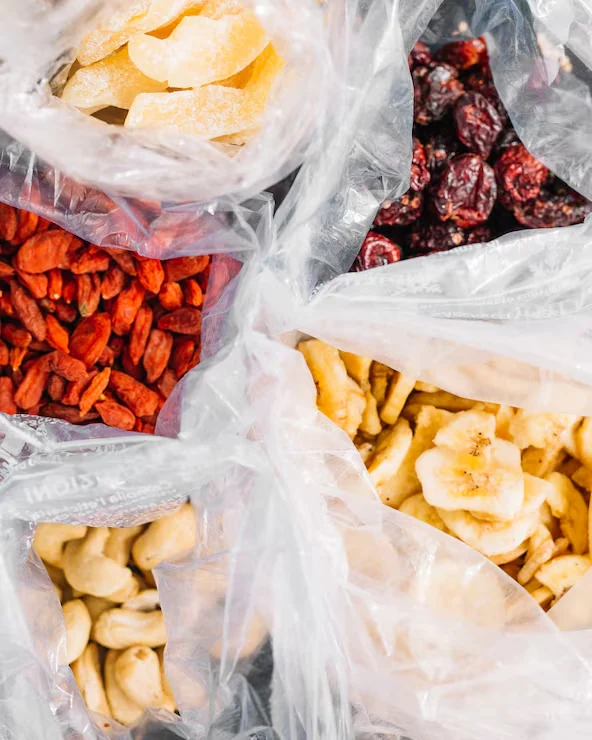
A dry-fruit range includes almonds, raisins and a gift assortment. Equal weights may occupy different volumes and present differently behind a window. Compare each product at its own intended fill rather than copying one size across the range. For a zipper pouch, review access and reclosure after repeated portions; for a gift pack, review how the filled pouch sits inside the outer presentation.
For this decision, start with the nut size, product bulk and portion pattern. The useful output is the usable cavity and closure checked with the actual product. Put that output beside the relevant quotation, drawing or sample rather than leaving it in a separate email. This is an illustrative decision exercise, not a report of a completed customer trial.
Product references to make the discussion concrete
The catalogue includes jar-shaped zipper pouches and window pouches. These examples show different physical constructions; they are not interchangeable specifications. A contoured outline gives the pouch a jar-like silhouette while retaining a flexible pack construction. The narrow shoulder and top opening affect filling and access. Review the usable cavity, zipper length and artwork boundaries on a dimensioned drawing before committing to the shape.
| Format reference | Material or construction to clarify | Details to include in the brief |
|---|---|---|
| Jar-shaped zipper pouches | Clear or frosted flexible pouch construction with a zipper; the jar shape is a profile, not a rigid container. | Usable cavity and narrowest opening; die-cut outline and corner radii. |
| Window pouches | A transparent window combined with paper-look or opaque flexible panels; confirm the full structure and product requirements. | Window width, height and location; product visibility at full and low fill. |
Use the reference pictures to identify the base, side panels, window or opening that you mean. A picture cannot supply the missing dimensions or material layers. If a photograph shows a finish or closure you do not want, state that difference explicitly; otherwise a visual reference can introduce an unintended requirement.
Complete the record before requesting the next sample
- Attach the usable cavity and closure checked with the actual product. Identify the product or SKU and the date of the observation.
- Record the nut size, product bulk and portion pattern. Keep confirmed information separate from proposed values and questions for the supplier.
- Add the actual fill weight or volume, the dimension convention, material proposal and intended closure. Include the number of designs and quantity per design when requesting a quotation.
- State which question the next drawing, sample or quotation must resolve. A change of size, closure or material should remain visible alongside the earlier reference.
This record makes the next conversation specific. It lets the design, purchasing and packing teams work from the same proposed item and shows which decision still needs evidence. Review the related product pages for format details, or prepare a custom packaging brief with the unresolved requirements.
Request a reviewable proposal
For an illustrative enquiry, whole roasted cashews and chopped cashews at the same declared weight should be identified as different product forms even if the buyer hopes to share a pouch size. The trial can establish whether a common component is practical; the category name alone cannot.
Send Navkar Poly Print the whole-nut worksheet, representative product, target quantities and packing route. Ask for dimensioned samples that resolve fit and access, with technical suitability and commercial scope reviewed against the actual application.
Sources and scope.
These references support the technical discussion. Product photographs illustrate formats; the material, dimensions and suitability of the proposed pack are confirmed for each project.
- Almond Board of California: moisture migration and management
Almond behaviour depends on processing state and environment; no shelf-life duration inferred.
- UC Davis walnut quality and handling guidelines
Handling and storage are material parts of nut quality; no duration or packaging guarantee inferred.
- Lin and colleagues: almond lipid deterioration during storage
Primary abstract compares specific almond forms under temperature/humidity combinations; no shelf life or pouch suitability extrapolated.
Let’s discuss your product.
Share your contents, dimensions, filling method, quantity and delivery destination. We’ll work through the proposed packaging specification with you.
Create a packaging brief