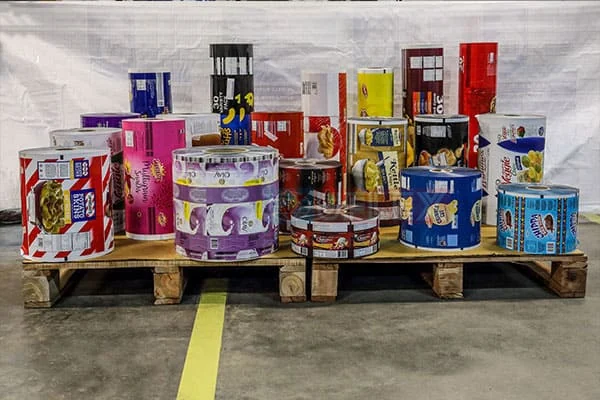
Ask the converter to show where the print sits in the proposed construction and from which side the customer views it. Surface and reverse printing describe different arrangements, but the terms do not establish the complete package performance. Use a cross-section and viewing arrow to align artwork, construction and finishing expectations. This is more useful than choosing a process term because another product appears glossy or protected.
Make the viewing path explicit
Request a conceptual layer view labelling the external viewing face, print location and product-contact side. The converter should confirm the arrangement for the actual proposal. Where artwork is viewed through a film, the appearance discussion needs that viewing path rather than a loose assumption about ink on the outside. Keep the structural view linked to the artwork file so production-facing orientation is handled by the responsible prepress team. Buyers should not mirror or rotate files informally to force a match with an unexplained sample.
Review appearance after the relevant finishing stages
The substrate and finish can influence the visual result, so identify which stage a proof or sample represents. Ask whether the evidence shows the proposed final construction or an intermediate print. Keep brand-colour and detail approvals tied to their actual reference. Do not claim that one print arrangement is always more resistant, higher quality or suitable for every application. The complete system and its evidence determine those decisions. If the material or finish changes, ask the print and technical owners which accepted appearance or performance references need review.
Keep functional interfaces in the discussion
Ask the technical team to identify any requirements involving ink, coatings, sealing or product-contact conditions. The purchasing record should capture the question and the applicable evidence, not prescribe chemical suitability from a process label. Include functional zones such as seals and coding areas on the layout. A decision about print location may connect to lamination and downstream converting, so update the route record when the proposal changes. The objective is an identified construction and evidence chain, rather than a general promise attached to the word reverse.
Use a viewing-construction card
The card makes the arrangement understandable to the brand and prepress teams while preserving the technical ownership of materials, inks and process conditions.
| Record | What to capture and how to use it |
|---|---|
| Viewing face | Show the customer-facing surface with an arrow through the proposed construction. Link the artwork orientation and ask the converter to confirm the view so the buyer does not infer it from gloss or the appearance of a loose sample. |
| Print location | Mark the intended position of print and any relevant coating within the layer view. Treat the drawing as a communication aid and link it to the approved specification rather than using an informal diagram as the only material requirement. |
| Appearance reference | Record which proof or sample represents the substrate and finish. State known differences from final production, enabling the visual approver to accept the demonstrated scope without claiming that an intermediate print proves the completed pack. |
| Functional review | List seal, code-area and contact questions for the responsible technical owners. Request applicable evidence for the proposed system instead of deriving suitability or durability from a broad print-arrangement term. |
| Change linkage | Identify lamination, finishing and artwork records affected by a proposed arrangement change. Record the approved revision and remaining evidence so the route, construction and visual references continue to describe the same packaging item. |
Use the card when comparing proposals that appear similar externally. Two packs can look alike while placing different components in the construction, and the buyer needs to know what has actually been proposed and evidenced.
Illustrative appearance reference mismatch
A brand approves a loose printed film for a proposed multilayer pack. The final construction has not yet been represented in the evidence, so the team records the approval as an intermediate appearance review. It requests the appropriate completed-construction reference before accepting final appearance. The example does not predict a colour shift or a performance problem; it shows why the viewing path and finishing stage should be identified before a sample is called representative.
Bostik provides laminate-system context. BOBST lists printing and converting processes.
Draw the layer stack from the viewer to the product
Begin with the surface the customer sees and trace towards the product-contact side. Mark the location of the print and any layers in front of or behind it. Surface and reverse printing describe print location relative to the viewing arrangement, while the full construction establishes what else is present. A format name or photograph cannot resolve the layer stack.
Ask the supplier to confirm the proposed stack in ordinary words and on a labelled diagram. Include any white backing or other appearance-related layer that is part of the proposal. The diagram is a description of the item, not proof of its suitability. Relevant functional and application evidence should identify that same construction so the visual and technical reviews concern one proposal.
Explain why the background changes appearance
Ink is viewed with the substrate, backing and lighting rather than in isolation. A graphic over a clear region can look different when the product is behind it. A white or other backing can alter the observed result. Use a representative construction and background for an appearance decision, recording what the reference actually contains.
Glenroy's graphics specifications explicitly ask designers to consider substrate tint in colour matching. This is direct manufacturer guidance for controlling the viewing construction, not a universal colour tolerance. Ask the current printer how the proposed structure and print location will be represented in the agreed proof or physical reference.
Keep exposure questions tied to the actual face
Identify which printed or unprinted surfaces may be touched, rubbed or exposed during the intended handling. Ask the technical owner what evidence is needed for those conditions. Do not infer abrasion resistance, contact suitability or chemical compatibility simply because the print is described as surface or reverse. The complete construction and intended use determine the relevant assessment.
If a layer is proposed to protect or support the print, record it as part of the specification. A statement about the route should not substitute for the identified material and evidence. Similarly, a sample from another product may demonstrate an appearance concept without establishing performance for the current filling, handling or storage conditions.
Compare the same graphic on equivalent references
Show the orientation of each specimen in the record. Turning a multilayer sample over can change the view, so a comparison photograph should identify the face intended for the customer.
Use the same artwork size and critical colour areas when reviewing alternatives. Place the references under the agreed viewing condition with the intended background where relevant. Record whether a difference arises in a clear region, backed region or another location. This produces a precise observation that the printer can investigate rather than a broad statement that one route looks richer.
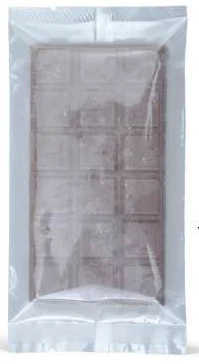
For an illustrative clear window design, compare the printed panel with and without representative product behind it. If the text becomes difficult to read over a dark product, investigate the backing and layout rather than assuming a change in print location alone will solve it. Keep the revised appearance reference linked to the proposed construction.
Review a construction change across both decisions
If the print location or surrounding layer arrangement changes, identify which appearance and functional evidence needs reassessment. A colour reference made through a different viewing stack may no longer answer the same question. A retained technical report may also have a defined construction scope that needs review. Ask the responsible owners to document applicability instead of silently carrying every approval forward.
The completed enquiry should let procurement point to the intended viewing face, locate the print and identify the accepted appearance reference. It should also name the owner of the relevant functional review. This connects design intent to a real proposed construction without inventing equipment details, a universal durability advantage or product-contact approval from a print-route label.
Production artwork handover: a practical specification example
A printed pouch is approved visually and then changes during conversion. Treat the artwork, film construction and finished geometry as separate records with shared revision references. Printed colour alone cannot show whether a seal width or usable cavity has changed. Compare a finished sample with the drawing and identify which observations concern print and which concern pack construction.
For this decision, start with the final files and superseded revisions. The useful output is one clearly named current artwork package per SKU. Put that output beside the relevant quotation, drawing or sample rather than leaving it in a separate email. This is an illustrative decision exercise, not a report of a completed customer trial.
Product references to make the discussion concrete
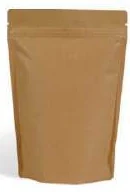
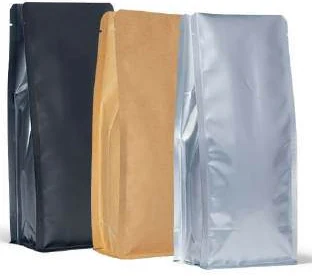
The catalogue includes flat-bottom pouches and foil-look stand-up pouches. These examples show different physical constructions; they are not interchangeable specifications. A box-style base gives the filled pack a distinct footprint, with separate front, back and side panels. Compare a plain top opening with a regular zipper, and use filled samples to decide the shelf depth and panel proportions.
| Format reference | Material or construction to clarify | Details to include in the brief |
|---|---|---|
| Flat-bottom pouches | Flexible laminate with paper-look or opaque outer options; the appearance alone does not identify the full layer structure. | Base width and full opened depth; net fill and product bulk. |
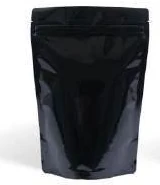
| Foil-look stand-up pouches | Opaque or metallic flexible laminate; foil and metallised constructions must be distinguished in the written specification. | Foil versus metallised requirement; outer finish and print coverage. |
Use the reference pictures to identify the base, side panels, window or opening that you mean. A picture cannot supply the missing dimensions or material layers. If a photograph shows a finish or closure you do not want, state that difference explicitly; otherwise a visual reference can introduce an unintended requirement.
Complete the record before requesting the next sample
- Attach one clearly named current artwork package per SKU. Identify the product or SKU and the date of the observation.
- Record the final files and superseded revisions. Keep confirmed information separate from proposed values and questions for the supplier.
- Add the actual fill weight or volume, the dimension convention, material proposal and intended closure. Include the number of designs and quantity per design when requesting a quotation.
- State which question the next drawing, sample or quotation must resolve. A change of size, closure or material should remain visible alongside the earlier reference.
This record makes the next conversation specific. It lets the design, purchasing and packing teams work from the same proposed item and shows which decision still needs evidence. Review the related product pages for format details, or prepare a custom packaging brief with the unresolved requirements.
Approve the actual arrangement
Keep the accepted viewing-construction card with the artwork and material specifications. Ask the supplier to explain any proposed change before production and identify affected evidence. Use qualified technical review for suitability questions. The resulting brief lets both parties discuss a concrete construction and final viewing condition instead of treating a process term as a complete packaging specification.
Send the completed viewing-construction card with your product and filling details to Navkar Poly Print for a project-specific discussion. Ask for the proposed specification, evidence required and open questions to be recorded before quotation approval.
Sources and scope.
These references support the technical discussion. Product photographs illustrate formats; the material, dimensions and suitability of the proposed pack are confirmed for each project.
- Bostik laminate adhesives
Adhesive manufacturer context for flexible lamination; suitability and process conditions remain project-specific.
- BOBST flexible packaging processes
Current equipment-manufacturer process reference. Narrow contextual citation only; no Navkar machinery or performance inference.
- Graphics Specifications
Discusses proof scope, substrate tint and positive/reversed fine-detail differences. Scope: Supplier-specific flexographic guidance; numeric limits and proof claims not transferred to another printer.
Let’s discuss your product.
Share your contents, dimensions, filling method, quantity and delivery destination. We’ll work through the proposed packaging specification with you.
Create a packaging brief