Start a home care refill pouch enquiry with the exact product information and authorised use instructions. The packaging supplier and competent product specialists need a defined application before judging components, closures or a proposed construction.
Describe the product through controlled information
Identify the product formulation or technical reference and the person authorised to share supporting information. Ask that person which documentation must accompany the enquiry, including relevant product safety information. Keep different cleaners or detergents as separate applications unless technical review establishes a common scope.
This article provides a procurement workflow, not chemical handling or formulation advice. Use the product owner's approved procedures throughout sampling and evaluation. Do not infer that a pouch used for shampoo or food is suitable for a household formulation.
Obtain product information from the authorised owner
Identify the exact household formulation and current technical reference. Ask the product owner which documents are needed for supplier discussion, sampling and assessment. Different detergents or cleaners should not be merged into a single application because they share a visual design.
UNECE's GHS publication describes hazard communication through labels and safety data sheets. That explains the purpose of such information. A safety data sheet is not a pouch-compatibility test, and this reference does not determine the current legal requirements for the buyer's market.
Keep all handling and trial activity under the product owner's authorised procedures. Procurement should share approved information through the agreed process and name the competent technical contact. It should not derive chemical handling instructions from a generic packaging article.
An illustrative range may contain two household products with identical nominal volumes and different formulation references. Give each a separate row for technical evidence, instructions and receiver. Common branding can be organised later without assuming common suitability.
Define the refill destination and closure
Describe the receiving container, intended transfer quantity and whether any product remains in the pouch after first use. Identify cap and fitment references and ask the reviewers to determine required compatibility and performance evidence. A closure's appearance does not establish its function for the proposed product.
ZACROS links design choices to contents in its refill portfolio. This is a useful application-specific principle, not a recommendation to copy that system. Your own product, components and distribution need review.
Define the complete refill destination
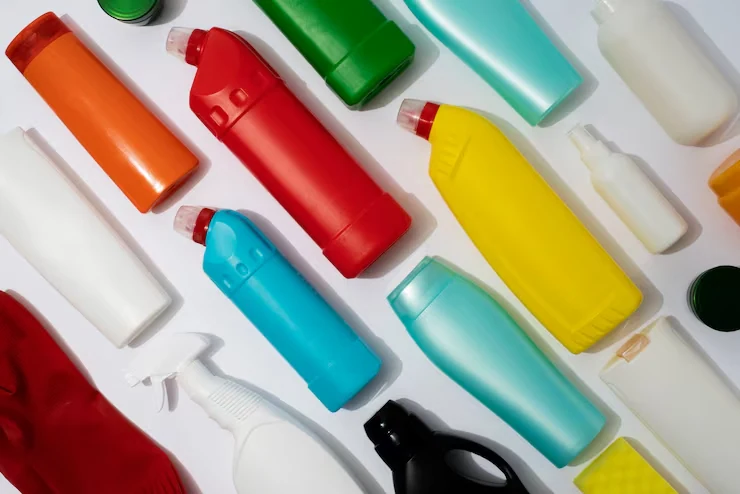
Record the actual receiving container and its authorised role. Include opening, relevant closure parts, intended receiving quantity and whether the pouch retains product for another use. A general bottle image cannot describe every interface.
Give the proposed body, fitment, cap and final closure their supplier references. Ask the competent team what compatibility and function evidence is needed for the actual formulation and use. Appearance alone does not establish either.
For an illustrative development conversation, a large open receiver can help demonstrate one transfer geometry while the commercial bottle remains unavailable. Label that limitation clearly. The later receiving-container task stays open until the intended interface is assessed.
Avoid adding instructions for rinsing, dilution, mixing or reuse unless the authorised product owner supplies them and the relevant review accepts them. The refill proposition should follow the approved product information. The packaging team's task is to make the intended physical sequence clear and assessable.
Check whether the quotation describes the same final closing and outer-packing scope as the technical brief. An offer for empty components is different from an offer including other agreed operations. Make included and excluded work visible before comparing prices.
Where a requirement remains unconfirmed, name it and obtain the relevant capability response. Procurement can continue collecting commercial inputs while that gate is open. It should not insert a presumed technical capability or a zero cost merely to make the proposal comparison look complete.
Keep label responsibility explicit
Give the brand's authorised text owner responsibility for directions, product identity, warnings and market-specific wording. The converter needs approved artwork and panel placement; it should not be expected to invent application instructions. Cosmetics Europe's information-exchange guidance is specific to cosmetics, but illustrates the value of separating supplier information from specialist decisions. It is not household-product approval.
Keep cosmetic references within their actual scope
A supplier may show a personal-care refill as a format example. It can help discuss dimensions or an opening arrangement, but it does not demonstrate suitability for a household formulation. Record what the reference actually represents.
Keep product-pack assessment under the relevant specialists for the current application. A cosmetics information-exchange document can illustrate how responsibilities are organised without becoming a home-care approval or a chemical compatibility method.
An illustrative evidence ledger might list a format photograph as visual context, a component specification as supplier information and a product-owner assessment as the application decision. Keeping those roles separate prevents a technically impressive reference from being used to answer the wrong question.
If a proposed construction or closure changes, have the relevant owners identify affected evidence before ordering. A shared front design can conceal a different contact system. The supplier should receive one current assembly instruction, with any conditional scope and accepted deviations explicit.
Separate household products within one range
Suppose a brand asks for one visual design across a laundry product and a surface-care product. Create separate technical rows even if the pack volumes match. Attach each product reference, receiver, instructions and proposed assembly. Share common artwork elements only after the text owner has separated variant-specific information. Ask the technical team whether any evidence can be shared and record its decision. This allows a coordinated range design without assuming that two different formulations have the same packaging requirements, use instructions or approval history.
Assign product-specific content before range layout
Have the authorised text owner supply directions, identity, warnings and market-specific wording for each actual product. Record the approved source and revision. A designer's earlier file should not become the authority for current technical content.
Separate shared brand elements from variant-specific text. Review a common element across the range, then review every complete SKU against its own approved source. A contact sheet of fronts cannot establish that each back panel belongs to the correct formulation.
An illustrative mismatch could show the intended laundry product front paired with surface-care directions. The issue is identity and content control, even if the pouch geometry is correct. Resolve it through the authorised owner before print release.
Keep code and variable-information tasks identified separately. A correct preprinted proof does not establish the later coded output. The packing and content owners should confirm the representative completed pack through their actual process, retaining the relevant reference for routine checking.
Record the home-care application and authorised text
Use this original worksheet with your product and supplier team. Give each row a named owner and evidence reference; a blank answer remains an open decision.
| Record | What to enter and why |
|---|---|
| Product reference | Identify exact formulation or technical document and the authorised owner of supporting safety information. |
| Refill destination | Attach receiving-container references and describe the approved transfer and remaining-product use pattern. |
| Pack assembly | List the proposed body, fitment, cap, final closure and dimensional drawing. |
| Approved text | Supply variant-specific directions and market wording from the responsible brand reviewer. |
| Assessment scope | Record product-pack, filling, transport and use requirements defined by competent specialists. |
Release a product-specific application within the range
Link formulation, receiver, assembly, instructions, complete artwork and relevant evidence. State what each owner accepted and which questions remain open. A business review can assess the organisation and commercial scope without implying completed technical testing.
For a shared component proposal, retain separate application rows and the specialist's rationale for any shared evidence. The supplier can then quote a coordinated range while the business preserves the actual product distinctions.
At repeat order, compare current references with the release index. A new formula, changed receiver or component substitution should trigger the relevant impact review. Keep any old-stock decision with the authorised business and technical owners rather than assuming printed material remains usable.
Use actual quantities, delivery destination and outer-packing scope for commercial comparison. Technical suitability and freight economics remain different decisions. The resulting brief gives procurement an orderable current proposal without an unsupported claim that a familiar refill format suits all household products.
Refill format choice: a practical specification example
A refill concept starts with the formulation and dispensing route. The contents may contact the laminate, spout and cap, so each part belongs in the compatibility brief. A clear pouch shown with another product does not prove suitability for shampoo, oil or cleaner. Keep the intended pour, refill opening and transport handling visible while comparing the package with a bottle.
For this decision, start with the original container and customer use pattern. The useful output is a comparison of pack access, pouring and residual product. Put that output beside the relevant quotation, drawing or sample rather than leaving it in a separate email. This is an illustrative decision exercise, not a report of a completed customer trial.
Product references to make the discussion concrete
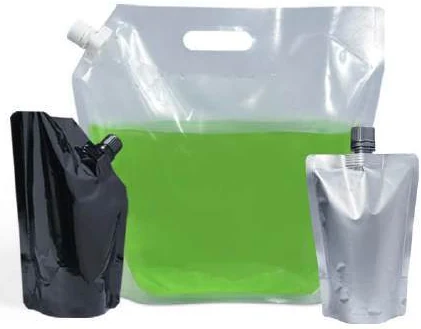
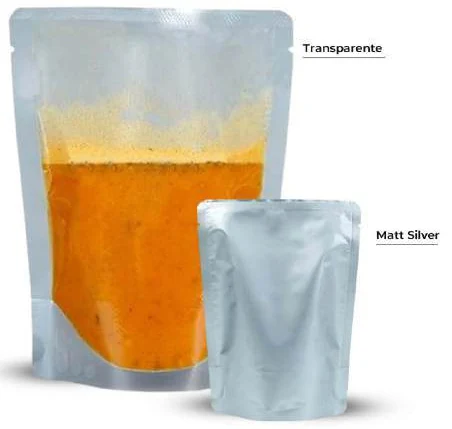
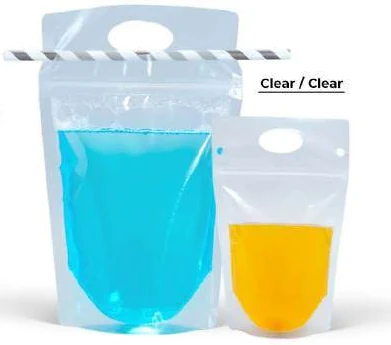
The catalogue includes spout pouches and beverage pouches with handles. These examples show different physical constructions; they are not interchangeable specifications. A fitted spout provides a controlled opening for dispensing. The reference range includes compact pouches and larger handled formats. Specify the product, fill volume, spout location and cap before developing the pouch shape; a corner spout and a top-centre spout require different layouts.
| Format reference | Material or construction to clarify | Details to include in the brief |
|---|---|---|
| Spout pouches | Flexible liquid-pack laminate with a fitted spout and cap; contact-layer and closure compatibility are reviewed for the formulation. | Fill volume and product viscosity; spout bore, position and cap. |
| Beverage pouches with handles | Transparent liquid-pack construction; contact layers and sealing requirements are reviewed for the beverage. | Beverage composition and fill volume; filling and final sealing method. |
Use the reference pictures to identify the base, side panels, window or opening that you mean. A picture cannot supply the missing dimensions or material layers. If a photograph shows a finish or closure you do not want, state that difference explicitly; otherwise a visual reference can introduce an unintended requirement.
Complete the record before requesting the next sample
- Attach a comparison of pack access, pouring and residual product. Identify the product or SKU and the date of the observation.
- Record the original container and customer use pattern. Keep confirmed information separate from proposed values and questions for the supplier.
- Add the actual fill weight or volume, the dimension convention, material proposal and intended closure. Include the number of designs and quantity per design when requesting a quotation.
- State which question the next drawing, sample or quotation must resolve. A change of size, closure or material should remain visible alongside the earlier reference.
This record makes the next conversation specific. It lets the design, purchasing and packing teams work from the same proposed item and shows which decision still needs evidence. Review the related product pages for format details, or prepare a custom packaging brief with the unresolved requirements.
Put the decision into practice
1. Separate the products. Create an application brief for each formulation instead of treating all home care refills as one category.
2. Collect authorised inputs. Ask the product owner to supply the relevant technical information and approved handling procedures.
3. Review the assembly. Have specialists assess the proposed complete pack and define representative evaluations.
4. Approve the range carefully. Release shared design elements and product-specific decisions under separate controlled references.
Send Navkar Poly Print the product-specific brief and authorised technical contact when asking about a home care refill pouch.
Sources and scope.
These references support the technical discussion. Product photographs illustrate formats; the material, dimensions and suitability of the proposed pack are confirmed for each project.
- Cosmetics Europe: packaging information exchange
Primary industry guidance separates supplier information from the assessor responsibility; EU context does not establish Indian compliance.
- ZACROS: Flowpack NT tube refill pouch
Manufacturer relates its tube selection to contents and receiving-bottle opening; no claim Navkar makes this proprietary system.
- UNECE GHS Revision10 publication record
Official publication describes hazard communication including labels and safety data sheets; not cited as latest edition, local legal advice or compatibility proof.
Let’s discuss your product.
Share your contents, dimensions, filling method, quantity and delivery destination. We’ll work through the proposed packaging specification with you.
Create a packaging brief