Cosmetic pouch compatibility belongs to the actual formula and final pack assembly. Build the enquiry around those identities and ask the competent product team to define the assessment, rather than accepting a general material label as a complete answer.
Record more than the film name
Identify the proposed body structure, sealant, fitment, cap and other relevant components through supplier references. Ask the technical team which materials information is needed and how confidential information will be exchanged. A simple abbreviation may help identify a proposal, but it rarely explains its full evidence scope.
Cosmetics Europe describes information exchange along the packaging value chain. The document does not replace a product safety assessment or establish a universal cosmetic compatibility method. Use it to clarify who supplies information and who interprets it.
Identify the complete contact system
Ask the competent team which component and material references the assessment needs. Include the actual proposed body, fitment, cap and final closure, plus other relevant items it identifies. A common film abbreviation does not establish the full assembly.
Keep the formula revision attached to that proposal. A similar lotion or oil can provide background but does not approve the current formulation. The specialist decides whether any existing evidence is relevant and what information remains missing.
Cosmetics Europe and CTFA's stability guidance discusses possible product-container interactions, including transfer or uptake of constituents and barrier-related effects. It supports an actual-system assessment, while offering no universal compatibility approval for a cosmetic pouch.
Procurement's role is to keep the identities and information requests traceable. It should not decide a chemistry question from a material name or a sample's appearance. Record the specialist's required inputs and the supplier response so the eventual conclusion has a clear evidence basis.
Define the proposed exposure and use
The assessment brief should identify the formula, filling conditions, storage proposal, use sequence and intended market. Ask the responsible product specialist to decide the relevant studies and acceptance criteria. Procurement should record the agreed plan and component identities, not invent a test duration or declare a formula safe.
ZACROS selects designs in its refill range according to content characteristics. This is further reason to describe the product precisely. Another manufacturer's successful application is context, not transferable proof for your formula and pack.
State the exposure the assessor is being asked to cover
Record filling conditions, storage proposal, distribution and authorised use through the product owner's current documents. Keep a target duration distinct from a demonstrated conclusion. The assessor needs the intended exposure to define relevant work.
ISO/TR 18811's official abstract leaves stability methods and conditions to a justified manufacturer protocol. It does not prescribe one universal test schedule. Use that scope distinction when commissioning the product-specific programme rather than inserting familiar temperatures or durations into the RFQ.
If the product is refilled into another container, keep that receiver and authorised sequence identified. The pouch assessment and the receiving-container proposition can involve different questions. The responsible team decides how they are addressed.
An illustrative brief may leave a proposed storage statement pending while identified development samples support geometry work. That is a legitimate bounded stage. It should not be represented as evidence that the final product is compatible throughout the intended period.
Keep product and pack observations in separate fields during an assessment. A visible pack change and a measured formula result may occur together, but their relationship needs technical interpretation. Preserve sample identity, timing and conditions so the specialist can examine the actual sequence.
Avoid rewriting an unresolved observation as a compatibility failure or success in the commercial summary. The summary should carry the authorised conclusion and reference. This protects useful early findings from becoming a broader claim through repeated email or quotation reuse.
Make changes visible before ordering
Ask suppliers to notify the project owner of proposed changes affecting the reviewed assembly. A substituted cap, resin grade, adhesive system or other material change should be routed through the agreed review process where relevant. The same front-panel design can conceal a different technical proposal.
Read the document's object before its conclusion
For each report, identify material or assembly, product, method, conditions and outcome. A genuine report can be useful while still covering a different proposal. Its authenticity does not remove the need to compare its scope with the current application.
Keep supplier information distinct from assessment. A composition statement supplies an input; a product-pack study assesses specified conditions; a physical refill observation concerns an actual task. They contribute different evidence and should not share an unexplained approval field.
For an illustrative gap, a body report may reference assembly A1 while the quote includes cap C3 that was not part of A1. Ask the assessor whether the difference affects coverage and what is needed. Do not assume it is irrelevant because the cap colour matches.
Record actual access limits. If only a public abstract or summary was reviewed, say so in the evidence file. The project should not claim inspection of a complete dataset or proprietary procedure that was never supplied.
Locate gaps in the compatibility evidence
Take a project file containing a body-film data sheet, an unlabelled sample and a statement that a similar lotion has used the format. Create three rows: identity confirmed, intended-use coverage and application conclusion. The data sheet may help with the first row, while the unlabelled sample leaves even identity unresolved. The similar application can inform discussion without closing the current assessment. Ask the product specialist what additional information is needed. This exercise helps purchasing recognise an evidence gap without trying to interpret material chemistry or replacing the assessor's judgement.
Evaluate a proposed substitution before it becomes the order
Ask suppliers to identify relevant proposed changes through the agreed notification route. Record the old and new references and why the change is being offered. A substitute may be acceptable, but it needs the accountable decision before production instruction.
Map the change to affected evidence. A component substitution can alter the assembly while artwork remains unchanged. A formula revision can affect the application even where all purchased component codes stay fixed. The mechanism determines the review path.
An illustrative notification could identify a changed cap reference and leave release pending specialist review. Procurement can obtain scope and quotation information while that decision is open. It should not convert commercial similarity into a technical equivalence claim.
Retain the accepted result and its limits in the assembly index. A separate email saying fine can lose meaning when several sample rounds exist. The useful record states which combination was assessed, which evidence was retained or renewed and who accepted it.
Record formula, exposure and component coverage
Use this original worksheet with your product and supplier team. Give each row a named owner and evidence reference; a blank answer remains an open decision.
| Record | What to enter and why |
|---|---|
| Formula identity | Record the final formula revision and owner responsible for the product assessment. |
| Pack components | List supplier references for the body, fitment, cap and other relevant contact components. |
| Intended exposure | Describe authorised filling, storage and use conditions for the specialist to assess. |
| Evidence coverage | Identify each document or study and the exact materials, product and conditions it covers. |
| Change notification | Agree which proposed material or component changes require notice and technical review. |
Release the assessed combination with a clear boundary
Match final formula, complete assembly, intended conditions and evidence references. State accepted conclusions through the relevant specialists and keep open questions assigned. An attractive mock-up and a complete folder do not by themselves establish compatibility.
Distinguish intended departmental business review from completed technical approval. Procurement and B2B reviewers can assess commercial scope and whether the file is ready for decision. Their involvement should not imply laboratory work or specialist credentials that were not supplied.
Before ordering, reconcile the quotation with the assessed component identities. Identify development-to-production differences and any accepted deviations. Keep the authorised record accessible to the people issuing repeat orders.
When a future change arrives, reopen the affected decision and preserve the history. The result is a maintained evidence relationship for an actual cosmetic product and pouch, rather than a generic material recommendation that expands to cover every formulation through repeated use.
Home-care refill: a practical specification example
A refill concept starts with the formulation and dispensing route. The contents may contact the laminate, spout and cap, so each part belongs in the compatibility brief. A clear pouch shown with another product does not prove suitability for shampoo, oil or cleaner. Keep the intended pour, refill opening and transport handling visible while comparing the package with a bottle.
For this decision, start with the formulation and contact conditions. The useful output is the laminate, spout and cap considered together. Put that output beside the relevant quotation, drawing or sample rather than leaving it in a separate email. This is an illustrative decision exercise, not a report of a completed customer trial.
Product references to make the discussion concrete
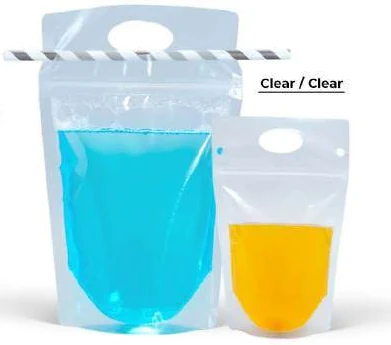
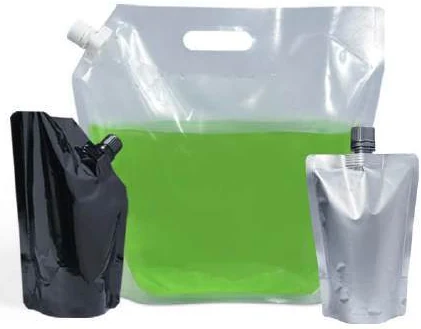
The catalogue includes spout pouches and beverage pouches with handles. These examples show different physical constructions; they are not interchangeable specifications. A fitted spout provides a controlled opening for dispensing. The reference range includes compact pouches and larger handled formats. Specify the product, fill volume, spout location and cap before developing the pouch shape; a corner spout and a top-centre spout require different layouts.
| Format reference | Material or construction to clarify | Details to include in the brief |
|---|---|---|
| Spout pouches | Flexible liquid-pack laminate with a fitted spout and cap; contact-layer and closure compatibility are reviewed for the formulation. | Fill volume and product viscosity; spout bore, position and cap. |
| Beverage pouches with handles | Transparent liquid-pack construction; contact layers and sealing requirements are reviewed for the beverage. | Beverage composition and fill volume; filling and final sealing method. |
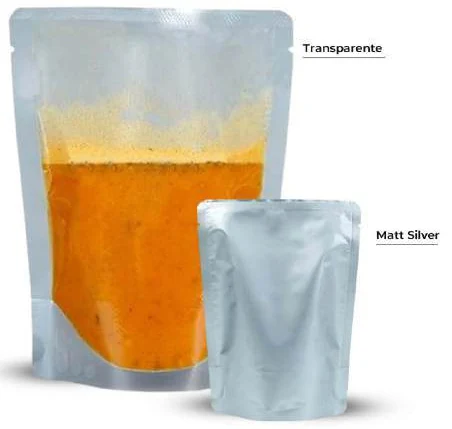
Use the reference pictures to identify the base, side panels, window or opening that you mean. A picture cannot supply the missing dimensions or material layers. If a photograph shows a finish or closure you do not want, state that difference explicitly; otherwise a visual reference can introduce an unintended requirement.
Complete the record before requesting the next sample
- Attach the laminate, spout and cap considered together. Identify the product or SKU and the date of the observation.
- Record the formulation and contact conditions. Keep confirmed information separate from proposed values and questions for the supplier.
- Add the actual fill weight or volume, the dimension convention, material proposal and intended closure. Include the number of designs and quantity per design when requesting a quotation.
- State which question the next drawing, sample or quotation must resolve. A change of size, closure or material should remain visible alongside the earlier reference.
This record makes the next conversation specific. It lets the design, purchasing and packing teams work from the same proposed item and shows which decision still needs evidence. Review the related product pages for format details, or prepare a custom packaging brief with the unresolved requirements.
Put the decision into practice
1. Establish identities. Connect the actual formula and complete pouch assembly before comparing supplier claims.
2. Commission the assessment. Ask the competent product team to define required information, studies and acceptance decisions.
3. Review evidence scope. Check references and coverage with the assessor rather than treating every data sheet as approval.
4. Maintain the accepted assembly. Use change notification and revision records to keep repeat purchases within the reviewed scope.
Provide Navkar Poly Print the formula reference and assessor's information request so the pouch discussion can address the actual compatibility evidence needed.
Sources and scope.
These references support the technical discussion. Product photographs illustrate formats; the material, dimensions and suitability of the proposed pack are confirmed for each project.
- Cosmetics Europe: packaging information exchange
Primary industry guidance separates supplier information from the assessor responsibility; EU context does not establish Indian compliance.
- ZACROS: Flowpack NT tube refill pouch
Manufacturer relates its tube selection to contents and receiving-bottle opening; no claim Navkar makes this proprietary system.
- Cosmetics Europe/CTFA: stability testing guidance
Primary historical guidance addresses contents-container interaction and representative marketed packaging; no universal protocol or Indian compliance inferred.
- ISO/TR 18811:2018 official public abstract
Public scope states cosmetic stability programmes need justified product-specific protocols; complete paid report not claimed read or implemented.
Let’s discuss your product.
Share your contents, dimensions, filling method, quantity and delivery destination. We’ll work through the proposed packaging specification with you.
Create a packaging brief