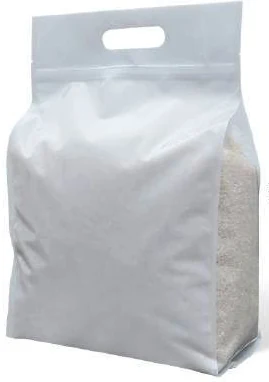
Confirm a four side seal pouch enquiry with a construction drawing before comparing quotations. The name alone can leave room for different assumptions about gussets, panel arrangement, loading opening and the finished shape.
Ask for a construction sketch
Show front, back and relevant folded or expanded views. Mark each seal, any gusset and the edge supplied open for filling. State whether dimensions refer to the flat pouch or a different convention. A photograph of a filled pack can help explain intent but should not become the only dimensional reference.
Craftz explicitly describes four-side-seal pouches with gusset. This illustrates a named construction, not a rule that every supplier uses identical terminology. Ask the converter to confirm the intended build rather than treating a product label as sufficient.
Link the construction to the product task
Record contents form, intended fill quantity, product-contact review needs and the packing route. Decide who will assess usable space and final closure. Avoid choosing a shape purely for the number of printable panels; filling and display requirements still need agreement.
SEE provides a distinct three-side-seal format reference. When comparing formats, describe the actual openings and folds on both proposals. Do not infer a performance advantage from seal count alone.
Approve the printed panels on the filled pack
Map front, back, side or other panels according to the agreed drawing. Review where seams and folds intersect important content. Keep the artwork revision tied to the construction revision, especially when a gusset or opening changes during sampling.
Describe the supplied state without relying on the name
Ask the supplier to show an empty pouch as delivered, with its open interface clearly marked. Add an expanded or sectional view wherever folds are important. Record which seals are already formed and what operation remains after loading. Two offers can use the same format name while referring to different supplied states. The comparison becomes meaningful only after the buyer can identify the physical work still needed at its own plant or co-packer.
Use a drawing legend consistently. Distinguish cut edges, formed seals, folds, gusset boundaries and the filling opening with separate line styles or labels. Do not rely on colour alone if the drawing may be printed in monochrome. State units and the orientation used to name front, back, top and bottom. A buyer should be able to describe one feature unambiguously during a call without pointing at an unlabelled photograph.
Separate the pouch from the packing route
Identify whether the plant plans to receive pre-made pouches or form the pack from rollstock. Mespack's pre-made machine overview describes feeding, transfer, opening, filling and top sealing as distinct stages. The practical implication is to ask which interfaces your own line requires. It does not establish compatibility with a proposed pouch. The line owner should assess the offered supplied condition against its actual equipment and accepted operating procedure.
Record the equipment contact and provide the relevant line information through the buyer's normal technical process. Ask who owns opening access, pouch presentation and final closure requirements. If the project is manually packed, describe that authorised task instead of borrowing an automatic-line specification. A format should not appear cheaper because one proposal leaves an additional operation to the buyer and the comparison omits its responsibility or cost.
Build a common quotation basis
Create one candidate code for the required construction and separate codes for alternatives. Give every supplier the same dimension convention, material brief, opening requirement, artwork version and quantity matrix. Require deviations to be stated against the candidate code. An alternative can be valuable, but it should remain visible as an alternative until the responsible reviewers accept its fit, process and application implications. A low unit figure alone cannot close those questions.
For an illustrative comparison, offer A is flat and supplied open on one edge; offer B includes an expanded feature and a different open edge. Mark the differences before entering either price in the commercial comparison. Ask the suppliers whether they can quote the common required construction or prefer to retain their alternative. If B remains an alternative, collect its own drawing and evidence. Do not enter a guessed adjustment to make unlike constructions appear comparable.
Review dimension language carefully
State whether a width is measured edge to edge in the flat supplied condition or describes another agreed feature. Record folded and expanded dimensions separately when both are needed. Use arrows and named reference points on the drawing. Descriptions such as standard gusset or normal seal leave the buyer unable to assess whether a later sample matches the offer. Ask the converter to propose the precise construction details for technical agreement.
A dimensional convention is not an acceptance tolerance. Keep nominal dimensions, proposed variation and the method for checking them in separate fields. Do not import a generic figure from a web page or a sample of another construction. The accepted requirement should identify what is measured, the sample condition and the responsible technical decision. This is particularly useful when the buying team receives a new size in the same visual family and assumes the old dimensions simply scale.
Coordinate panel identities with folds and seals
Create a panel map before the artwork is finalised. Identify the front display area, reverse information area and any surfaces revealed by expansion. Label the direction of readable text on each. Ask the brand and technical owners to review the same controlled construction drawing. A flat artwork file may show a continuous design while the finished pack places part of it on a folded or sealed region. The panel map makes that relationship visible early.
When a proposed construction changes, list affected panels and return the relevant questions to their owners. For example, adding an expanded feature may create a new visible surface and alter the relative position of existing text. The team must decide what content belongs there and whether the earlier proof remains applicable. Record the answer in the linked artwork and drawing revisions; a comment on a presentation image is insufficient as the active production reference.
Resolve ambiguity before sample approval
Use a clarification log with question, supplier answer, drawing reference and buyer decision. Close each line using the final agreed document rather than leaving the buyer to interpret several emails. Where the answer remains unresolved, identify what evidence is needed and who will decide. An honest open line is more useful than a broad assumption that the supplier's usual construction will be suitable.
The result should be a concise construction statement that another team can read independently: what is supplied, how it is dimensioned, how contents enter, who closes it and which drawing governs. Add application evidence as a separate linked requirement. This turns an ambiguous format enquiry into a reproducible quotation and sample task without assigning performance to a name or a seal count.
Illustrative quote clarification
Imagine two supplier proposals both labelled four side seal. One sketch includes a gusset and the other is flat. Put them side by side and mark seals, open edge and dimension convention before comparing price. Ask each supplier to quote the same confirmed drawing or identify its proposed alternative clearly. If the alternative deserves review, give it a separate candidate code and collect its own fit and filling evidence. This prevents a lower figure for a different construction being mistaken for a like-for-like saving.
A working record for this decision
Use this original worksheet with your product and supplier team. Give each row a named owner and evidence reference; a blank answer remains an open decision.
| Record | What to enter and why |
|---|---|
| Construction views | Provide front, back and folded or expanded views identifying every seal and gusset. |
| Dimension convention | State units and the measurement basis used for width, height and folded features. |
| Supply opening | Mark the edge or interface available for filling and final closure. |
| Product task | Describe contents, intended quantity, packing route and required application assessment. |
| Panel release | Connect artwork panels and critical information to the accepted construction revision. |
Shaped pouch: a practical specification example
A special retail profile must still provide a usable cavity and a practical opening. A hanging header, die-cut outline or carrying feature occupies material that cannot automatically be counted as product space. Start with a drawing of the actual product envelope, then place the feature and the artwork. Compare the filled pack on the intended fixture rather than judging only the flat silhouette.
For this decision, start with the narrowest opening and contour. The useful output is a dimensioned profile with an artwork safe area. Put that output beside the relevant quotation, drawing or sample rather than leaving it in a separate email. This is an illustrative decision exercise, not a report of a completed customer trial.
Product references to make the discussion concrete
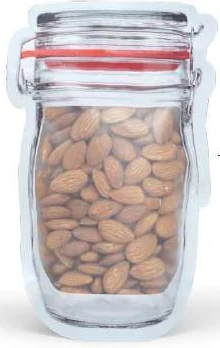
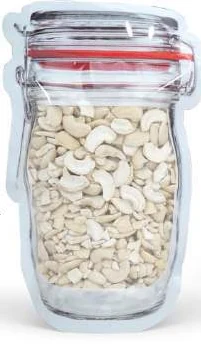
The catalogue includes jar-shaped zipper pouches and hanging display pouches. These examples show different physical constructions; they are not interchangeable specifications. A contoured outline gives the pouch a jar-like silhouette while retaining a flexible pack construction. The narrow shoulder and top opening affect filling and access. Review the usable cavity, zipper length and artwork boundaries on a dimensioned drawing before committing to the shape.
| Format reference | Material or construction to clarify | Details to include in the brief |
|---|---|---|
| Jar-shaped zipper pouches | Clear or frosted flexible pouch construction with a zipper; the jar shape is a profile, not a rigid container. | Usable cavity and narrowest opening; die-cut outline and corner radii. |
| Hanging display pouches | Clear or opaque flexible pouch construction with a punched hanging feature; final material and reinforcement are reviewed for the fill. | Retail hook and hole dimensions; filled weight and hanging orientation. |
Use the reference pictures to identify the base, side panels, window or opening that you mean. A picture cannot supply the missing dimensions or material layers. If a photograph shows a finish or closure you do not want, state that difference explicitly; otherwise a visual reference can introduce an unintended requirement.
Complete the record before requesting the next sample
- Attach a dimensioned profile with an artwork safe area. Identify the product or SKU and the date of the observation.
- Record the narrowest opening and contour. Keep confirmed information separate from proposed values and questions for the supplier.
- Add the actual fill weight or volume, the dimension convention, material proposal and intended closure. Include the number of designs and quantity per design when requesting a quotation.
- State which question the next drawing, sample or quotation must resolve. A change of size, closure or material should remain visible alongside the earlier reference.
This record makes the next conversation specific. It lets the design, purchasing and packing teams work from the same proposed item and shows which decision still needs evidence. Review the related product pages for format details, or prepare a custom packaging brief with the unresolved requirements.
Put the decision into practice
1. Clarify the format. Ask the converter to confirm the actual build behind the four side seal description.
2. Normalise proposals. Use one drawing as the quotation basis or label construction alternatives separately.
3. Review filled samples. Assess fit, panel visibility and packing interface through appropriate identified samples.
4. Release linked references. Keep construction, dimensions, artwork and closure responsibility together in the order file.
Send Navkar Poly Print a marked construction sketch when requesting a four side seal pouch quotation or sample review.
Sources and scope.
These references support the technical discussion. Product photographs illustrate formats; the material, dimensions and suitability of the proposed pack are confirmed for each project.
- SEE: Three Side Seal Pouches
Manufacturer format reference for a three-side sealed pouch; supplied features and suitability are not transferred to Navkar.
- Craftz: four-side seal pouches with gusset
Manufacturer format example demonstrates why drawings are needed to distinguish seal and gusset constructions.
- Mespack: Pre-Made Pouch Packaging Machine
Manufacturer describes pouch feeding, transfer, opening, filling and top-sealing stages; supports identifying interfaces, not compatibility with any Navkar construction.
Let’s discuss your product.
Share your contents, dimensions, filling method, quantity and delivery destination. We’ll work through the proposed packaging specification with you.
Create a packaging brief