Assign one accountable decision owner to each packaging requirement before asking everyone to approve the same proof. Brand content, technical material, manufacturing and filling questions require different evidence and expertise. A responsibility map makes those boundaries visible while keeping one coordinated project record. It is especially useful when a brand, designer, converter and co-packer all contribute to the final pack.
Separate the approval subjects
List the subjects requiring acceptance: content, artwork layout, print appearance, construction, converted geometry and the receiving filling interface. Adapt the list to the actual project. A designer can review file content and placement without being responsible for product compatibility; a line owner can review filling access without approving a translation. State these boundaries directly in the project record. This reduces the risk that a broad approved stamp will later be interpreted as an assurance about requirements that the signer never reviewed or had authority to accept.
Identify handovers where ownership can disappear
The difficult questions often sit between teams: a window changes artwork and construction, a zipper changes geometry and filling access, or a revised repeat affects both print and the packing route. Assign a coordinating owner for each interface while retaining the relevant technical approvers. Ask who issues the final accepted reference after comments are resolved. Without that step, each team may keep a different annotated file and believe another party has incorporated the changes. The map should identify who closes the issue, not merely who was copied into correspondence.

Make approval statements specific
Use statements that name the file, revision, evidence and covered subject. Record conditions and unresolved issues beside the decision. Silence after a circulated proof should not become a manufactured approval. If a required owner has not reviewed the change, keep that gate open and continue independent work that does not depend on it. Preserve dated decisions in one project index so a future reorder does not require reconstructing authority from a long message thread. Changes should return only to the owners of affected requirements, with dependencies assessed explicitly.
Build a requirement-to-owner map
The map is an original coordination tool, not a claim about any company's internal organisation. Replace role names with the actual people or approved functions for the project.
| Record | What to capture and how to use it |
|---|---|
| Requirement subject | Describe the decision being made and the relevant item or file. Keep content, appearance, construction and filling subjects distinct so a signature can be interpreted without assuming authority over the whole finished package. |
| Decision owner | Name the person or function accountable for accepting that subject. Record the basis of their authority within the project, and identify a replacement route so an absent contact does not leave an essential approval ambiguous. |
| Evidence reviewer | Identify who examines the required sample, document or trial. A reviewer may support an owner without making the final decision; state that distinction so technical comments do not automatically become commercial release instructions. |
| Interface coordinator | Assign the person who gathers cross-team responses and issues the clean accepted reference. Use this role for changes affecting several requirements, while preserving the separate technical decisions needed to close each one. |
| Decision record | Record the accepted revision, covered subject, conditions and unresolved issues. Link the evidence and date, then make the current status retrievable from the project index instead of relying on approval wording scattered through emails. |
Review the map when a supplier, co-packer or artwork agency changes. Familiar documents can conceal new responsibility gaps if the team assumes the previous organisation's role assignments still apply.
Illustrative shared-proof confusion
A brand manager approves text on a digital proof. The converter later asks whether that email also approved the pouch opening arrangement. The responsibility map shows separate content and filling gates, with the line owner still required for the latter. The project can continue content work while the geometry question is resolved. The example prevents a communication gap from becoming a false technical approval; it does not suggest that one role must personally perform every review.
BOBST lists distinct flexible packaging production processes. Esko outlines prepress handovers.
Separate authority from participation
Several people may contribute to an artwork or material discussion without having authority to approve every subject. Procurement can confirm commercial scope, while another owner may approve product information or assess a technical construction. Write the decision subject beside the role. A long email distribution list is not a responsibility map unless the required decision and authorised owner are clear.
Ask each participating organisation to confirm the owner for its interface. The supplier should identify its technical contact for the proposed construction or conversion question. The filling site should identify the owner of its receiving and closing requirements. The brand should identify who approves content and intended use. These are project roles, not claims that a particular person holds an unverified qualification.
Divide a broad approval into reviewable questions
Keep the role map current when personnel change. A departing contact should not leave an apparently assigned decision without someone able to accept the relevant evidence.
“Approve the sample” can conceal several decisions: geometry, copy, colour appearance, filling access and technical evidence. List them separately and identify the specimen or document that supports each. A reviewer may accept one subject and leave another open. The record should preserve that distinction rather than converting a broad signature into approval of everything associated with the sample.
For an illustrative pouch, procurement may accept the quotation scope while the filling owner requests another opening review. The commercial acceptance does not close the physical interface. Conversely, an accepted filling observation does not approve the final text. This separation allows work to progress on settled subjects while the remaining question has a clear owner and next action.
Use a handover question at organisation boundaries
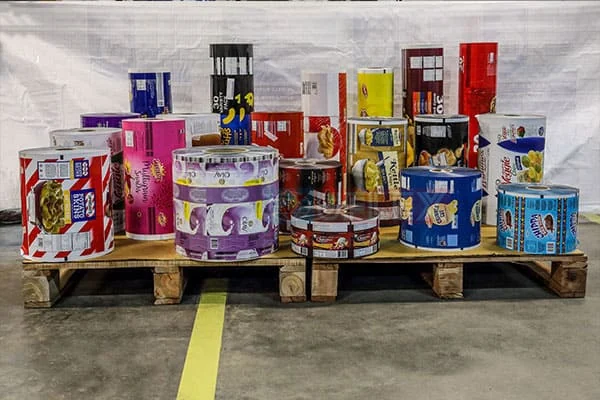
At each boundary, ask the receiver what it needs to accept the incoming item. A printer receives an agreed file and layout; a finishing operation receives an identified web; a filler receives a reel or pouch with its relevant interface specification. The responsibility map should connect those needs to the organisation providing the information.
BOBST's flexible-packaging overview distinguishes several manufacturing operations. Its relevance here is the existence of different process interfaces, not evidence about Navkar staffing or equipment. Use the actual route map to decide where coordination is needed and who can resolve a conflict between two stage requirements.
Make an unresolved decision visible
Use a short status vocabulary agreed by the project: accepted for the stated scope, conditional with a defined next action, or unresolved. Attach the evidence and decision date. A conditional result should identify the condition precisely enough that another person can verify whether it has been met. “Looks okay subject to quality” leaves the responsibility unchanged and the decision unclear.
If the relevant owner is unavailable, record the gap and route it through the project's nominated coordinator. Do not interpret silence, attendance at a meeting or receipt of an attachment as acceptance. The coordinator can collect evidence and ensure that a decision happens without pretending to provide the technical judgement assigned to another role.
Keep review changes connected to their subject
When a reviewer requests a change, record the affected requirement and document revision. Then ask which other owners need to reassess their interface. Moving a feature to improve access may affect artwork or filling space. Replacing text may affect layout. The responsibility map helps route those consequences without sending every minor correction to every person.
At final handover, ask whether each required subject has a decision from the agreed owner and a current evidence reference. Keep open subjects visible in the release discussion. The aim is a clear chain of accountable decisions that procurement and B2B heads can understand, while technical claims remain supported by the appropriate evidence. It is not an invented credential list or a general signature page that hides different responsibilities.
Converting sequence: a practical specification example
A printed pouch is approved visually and then changes during conversion. Treat the artwork, film construction and finished geometry as separate records with shared revision references. Printed colour alone cannot show whether a seal width or usable cavity has changed. Compare a finished sample with the drawing and identify which observations concern print and which concern pack construction.
For this decision, start with the agreed pouch drawing and closure arrangement. The useful output is the finished dimensions checked after conversion. Put that output beside the relevant quotation, drawing or sample rather than leaving it in a separate email. This is an illustrative decision exercise, not a report of a completed customer trial.
Product references to make the discussion concrete
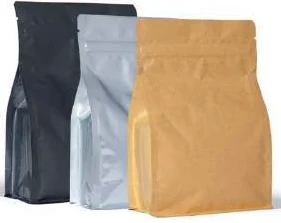
The catalogue includes flat-bottom pouches and foil-look stand-up pouches. These examples show different physical constructions; they are not interchangeable specifications. A box-style base gives the filled pack a distinct footprint, with separate front, back and side panels. Compare a plain top opening with a regular zipper, and use filled samples to decide the shelf depth and panel proportions.
| Format reference | Material or construction to clarify | Details to include in the brief |
|---|---|---|
| Flat-bottom pouches | Flexible laminate with paper-look or opaque outer options; the appearance alone does not identify the full layer structure. | Base width and full opened depth; net fill and product bulk. |
| Foil-look stand-up pouches | Opaque or metallic flexible laminate; foil and metallised constructions must be distinguished in the written specification. | Foil versus metallised requirement; outer finish and print coverage. |
Use the reference pictures to identify the base, side panels, window or opening that you mean. A picture cannot supply the missing dimensions or material layers. If a photograph shows a finish or closure you do not want, state that difference explicitly; otherwise a visual reference can introduce an unintended requirement.
Complete the record before requesting the next sample
- Attach the finished dimensions checked after conversion. Identify the product or SKU and the date of the observation.
- Record the agreed pouch drawing and closure arrangement. Keep confirmed information separate from proposed values and questions for the supplier.
- Add the actual fill weight or volume, the dimension convention, material proposal and intended closure. Include the number of designs and quantity per design when requesting a quotation.
- State which question the next drawing, sample or quotation must resolve. A change of size, closure or material should remain visible alongside the earlier reference.
This record makes the next conversation specific. It lets the design, purchasing and packing teams work from the same proposed item and shows which decision still needs evidence. Review the related product pages for format details, or prepare a custom packaging brief with the unresolved requirements.

Use the map at production release
Before issuing the production reference, check that each required subject has an accepted decision and the interfaces agree. Carry conditional items forward visibly. Use the map again during a change so reviewers receive the questions they can answer. This keeps coordination practical and helps the buyer request the right evidence without pretending that one signature proves every aspect of the pack.
Send the completed requirement-to-owner map with your product and filling details to Navkar Poly Print for a project-specific discussion. Ask for the proposed specification, evidence required and open questions to be recorded before quotation approval.
Sources and scope.
These references support the technical discussion. Product photographs illustrate formats; the material, dimensions and suitability of the proposed pack are confirmed for each project.
- BOBST flexible packaging processes
Current equipment-manufacturer process reference. Narrow contextual citation only; no Navkar machinery or performance inference.
- Esko packaging prepress process
Primary prepress-software supplier reference; workflow recommendations here are original buyer tools.
Let’s discuss your product.
Share your contents, dimensions, filling method, quantity and delivery destination. We’ll work through the proposed packaging specification with you.
Create a packaging brief