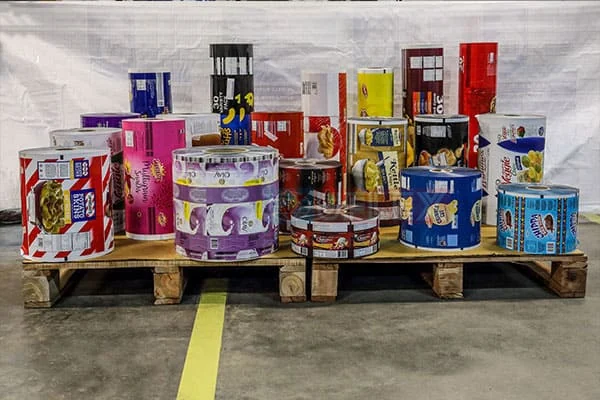
Specify slitting through the relationship between the required web edges and the printed layout. Correct width alone does not establish that graphics, eye marks or lanes sit where the receiving operation expects them. Add the required reel configuration and identification to make the finishing handover complete. Buyers should request a controlled layout and evidence, leaving machine setup and process decisions with the converter.
Map the lanes before discussing finished reels
Show the parent-web layout and the intended finished lanes using labelled conceptual views. Identify the graphics, registration marks and edge references that belong to each lane. If several SKUs share the layout, record the lane-to-SKU mapping clearly. Do not assume all lanes are identical or that a common width establishes the correct design. A buyer may receive several visually similar reels from one order; the finishing record should make it possible to distinguish them and trace each to its intended item.
Agree the edge relationship and measurement
Ask the converter and receiving line owner to agree web width, relevant edge-to-graphic references and their acceptance methods. Use a controlled drawing rather than measuring a photograph of a loose film sample. Keep the artwork revision visible, especially when designers move a panel or registration mark. Any proposed tolerance should come from the technical requirement and agreed process capability, not a generic number copied into the enquiry. Width and print position are related but separate observations and should be recorded that way when a sample is reviewed.

Finish the reel handover
Link the slit-web requirements to core, reel envelope, delivered unwind and label identity. These remain necessary even when the parent web and print appear correct. Ask what finishing evidence will accompany the first supply and how deviations will be communicated. For trial material, record whether finishing matches the intended production configuration. Do not use a successful hand-fed sample as proof that the delivered reel interface has been demonstrated. The receiving route needs evidence for the actual supplied form, including orientation and identity.
Use a slit-web finishing card
This card links the artwork layout to each delivered reel. It is especially useful where one print layout becomes several lanes or where similar designs need separate identification.
| Record | What to capture and how to use it |
|---|---|
| Parent layout | Record the controlled artwork and parent-web drawing references. Identify the proposed lane arrangement and any shared elements so the converter and buyer discuss the same starting layout before finished widths are released. |
| Finished lane | State the item or SKU assigned to each lane and its required web width. Keep the mapping explicit for mixed layouts, because identical dimensions do not establish that each reel carries the intended design. |
| Graphic position | Show the relevant printed references relative to the finished edges and the agreed measurement approach. Ask the receiving line owner to confirm functional mark requirements before treating the layout as approved for production supply. |
| Reel configuration | Link core, envelope and unwind to the slit-web record. Distinguish a loose sample from a delivered trial reel so evidence for print position is not misread as approval of the complete receiving interface. |
| Identity and evidence | Record the finished reel references, applicable revisions and agreed review results. Link any deviation to the affected reels and decision owner, preserving the relationship between the parent layout and the material actually shipped. |
Ask quotation respondents to state assumptions about lane arrangement and finishing. This can reveal differences in scope that would be hidden by comparing only a price for a nominal film width.
Illustrative correct width, wrong relationship
A sample web measures to the illustrative requested width, but the buyer has not agreed where the registration reference sits relative to its edge. The line team asks for the missing relationship before accepting the web. The buyer adds it to the controlled drawing and obtains the converter’s response. The example does not claim that the slitting was defective; it shows an incomplete specification. A precise acceptance record needs the dimensions and references that the actual receiving route uses.
Glenroy describes custom slitting and finishing. IoPP/SPMC provides specification context.
Keep the parent layout visible during finishing
A printed parent web can contain several lanes, trim regions or design sequences. The finished reel specification should identify the lane being supplied and its relationship to the parent layout. Without that link, a correct slit width may still leave artwork positioned differently from the approved finished-web drawing. Width and graphic position are separate observations.
Label lanes from an agreed reference edge and show which edge remains on the finished reel. Mark the artwork, registration area and any relevant clear margin. The slitting team and receiver should be able to point to the same relationship. Avoid relying on informal descriptions such as left reel when the viewing direction has not been defined.
Define the measurement rather than only the number
Keep the reference edge visible in photographs as well as tables. A cropped image of the printed design can conceal which side was measured, making an otherwise accurate reading difficult to interpret during a later comparison.
State the finished slit width in the agreed units, together with the acceptance method and range agreed for the actual job. Identify where graphic position is measured from: a slit edge, centreline or another controlled reference. A number copied from a flat artwork file may describe a different relationship from the finished reel measurement.
Glenroy's finishing page identifies film slitting as a finishing service. It supplies direct manufacturing context, not a tolerance for another converter. Ask the current supplier and receiver to agree the required finished-web relationship using the project drawing and actual line needs.
Interpret a width and position example
Suppose an illustrative finished web is specified at 250 mm, with a graphic reference intended 20 mm from one identified edge. A measured width of 250 mm does not prove that the graphic reference is at 20 mm. Conversely, a correctly positioned graphic does not establish the total slit width. The two checks answer different questions and need distinct entries in the receiving evidence.
These invented dimensions do not define acceptable variation. The project must agree the measurement conditions and acceptance range. If a discrepancy is observed, record the lane, reel identity and actual location. Ask the technical owners whether it concerns the parent print relationship, finishing position or another factor before assigning a cause.
Check the delivered reel configuration after slitting
Finishing changes the physical unit received by the packing line. Confirm core interface, reel width, outside diameter, mass requirements where specified and delivered unwind. A correctly positioned narrow web can still arrive in an unsuitable reel configuration. Keep these fields with the finishing drawing so an apparent width approval does not become an accidental approval of the whole delivered unit.
If rewinding or another finishing step is proposed, confirm the final orientation descriptively. Do not assume that an upstream print reference automatically describes the delivered reel. Compare the approved unwind drawing with the representative finished reference, using the same viewing convention. Retain the label identity so observations remain tied to the reel being discussed.
Preserve traceability without confusing lane and reel
A lane reference describes where the web came from on the parent layout. A reel identifier describes the physical finished unit. Both can be useful in an investigation, but they are not interchangeable. Ask how the supplier's records connect them and which information will be available to the buyer under the agreed arrangement.
When a line event occurs, retain the finished reel identity and the relevant graphic-to-edge observation. The converter can then review the parent relationship where appropriate. The closing finishing approval should state which geometry and delivered configuration were accepted. If another width, layout or lane arrangement is proposed later, review the changed relationship instead of assuming that previous acceptance of the material construction covers every finished-web version.
Lamination requirements: a practical specification example
A printed pouch is approved visually and then changes during conversion. Treat the artwork, film construction and finished geometry as separate records with shared revision references. Printed colour alone cannot show whether a seal width or usable cavity has changed. Compare a finished sample with the drawing and identify which observations concern print and which concern pack construction.
For this decision, start with the proposed layer sequence and product-contact side. The useful output is a construction description that distinguishes each layer and purpose. Put that output beside the relevant quotation, drawing or sample rather than leaving it in a separate email. This is an illustrative decision exercise, not a report of a completed customer trial.
Product references to make the discussion concrete
The catalogue includes flat-bottom pouches and foil-look stand-up pouches. These examples show different physical constructions; they are not interchangeable specifications. A box-style base gives the filled pack a distinct footprint, with separate front, back and side panels. Compare a plain top opening with a regular zipper, and use filled samples to decide the shelf depth and panel proportions.
| Format reference | Material or construction to clarify | Details to include in the brief |
|---|---|---|
| Flat-bottom pouches | Flexible laminate with paper-look or opaque outer options; the appearance alone does not identify the full layer structure. | Base width and full opened depth; net fill and product bulk. |
| Foil-look stand-up pouches | Opaque or metallic flexible laminate; foil and metallised constructions must be distinguished in the written specification. | Foil versus metallised requirement; outer finish and print coverage. |
Use the reference pictures to identify the base, side panels, window or opening that you mean. A picture cannot supply the missing dimensions or material layers. If a photograph shows a finish or closure you do not want, state that difference explicitly; otherwise a visual reference can introduce an unintended requirement.
Complete the record before requesting the next sample
- Attach a construction description that distinguishes each layer and purpose. Identify the product or SKU and the date of the observation.
- Record the proposed layer sequence and product-contact side. Keep confirmed information separate from proposed values and questions for the supplier.
- Add the actual fill weight or volume, the dimension convention, material proposal and intended closure. Include the number of designs and quantity per design when requesting a quotation.
- State which question the next drawing, sample or quotation must resolve. A change of size, closure or material should remain visible alongside the earlier reference.
This record makes the next conversation specific. It lets the design, purchasing and packing teams work from the same proposed item and shows which decision still needs evidence. Review the related product pages for format details, or prepare a custom packaging brief with the unresolved requirements.

Release the finished-web reference
Keep the finishing card with the rollstock specification and request explicit acknowledgement of revisions. Reassess it after artwork movement, lane changes, web-size changes or a new receiving route. Use reel identity when raising an incoming question. This gives the supplier a focused evidence request and gives receiving staff a practical basis for checking the supplied material.
Send the completed slit-web finishing card with your product and filling details to Navkar Poly Print for a project-specific discussion. Ask for the proposed specification, evidence required and open questions to be recorded before quotation approval.
Sources and scope.
These references support the technical discussion. Product photographs illustrate formats; the material, dimensions and suitability of the proposed pack are confirmed for each project.
- Glenroy custom finishing and slitting
Primary converter explanation of roll finishing; no claimed Navkar process details.
- IoPP/SPMC guide to writing rollstock specifications
Institute-hosted specification guide; medical-package context requires application-specific interpretation.
Let’s discuss your product.
Share your contents, dimensions, filling method, quantity and delivery destination. We’ll work through the proposed packaging specification with you.
Create a packaging brief