Approve non-food pouch artwork through separate checks for layout, product information and technical claims. A correct print proof can still contain unapproved wording, while approved wording can become unclear when placed over folds, seals or convenience features.
Give every content block a responsible owner
Create an index for product name, variant, directions, warnings, quantity, identifiers and claims as applicable. Ask the responsible brand or regulatory reviewers to supply and authorise market-specific content. The converter reviews reproduction and placement within the supplied construction; it does not own the formulation claims.
Cosmetics Europe describes supplier information supporting assessment. The same division of responsibility helps prevent a material document from being treated as permission to print an unrelated product claim. Claim approval should identify the wording and accepted supporting evidence.
Separate the source of content from its visual treatment
Give every product-information block an approved source and owner. Record the current wording for identity, directions, warnings, quantity, identifiers and claims as applicable. A previous design file is an asset, not automatically the authority for current content.
Keep the designer's layout decisions distinct from the meaning approved by the owner. A shortened sentence, changed symbol or reordered instruction can alter the message. Have the relevant reviewer accept meaningful edits rather than treating them as purely decorative changes.
For an illustrative record, claim Q1 can reference exact wording and the owner's accepted support, while direction U2 references the authorised use procedure. Different blocks can therefore follow different evidence routes within one complete artwork.
When several products share a visual system, retain separate complete content records. Common logo and typography rules do not establish common instructions or technical claims. A coordinated range can still require variant-specific wording and review.
Review the real construction drawing
Place artwork on the current pouch dieline with spout, handle, seals and other features identified. Retain construction layers in the review file. Check where the filled body may curve and where the user grips the pack, alongside the print-specific requirements supplied by the converter.
ZACROS relates design to contents and receiver in its refill range. A changed refill interface can affect instruction images even if the branding remains fixed. Keep those illustrations linked to the actual assembly and receiver references.
Map information to the actual pack regions
Use the current dimensioned construction drawing with features and seals identified. Distinguish the intended print regions from areas affected by folds, fitments, handles or routine grip. The converter supplies relevant production requirements through its accepted artwork process.
Inspect a representative filled arrangement where panel visibility or instruction placement matters. A flat proof can show copy and design relationships while leaving filled curvature unresolved. Record the particular task the mock-up supports.
An illustrative discrepancy may place an approved instruction image across a region hidden by the actual feature arrangement. The wording can remain approved while the layout needs revision. Keep that split visible so the correction reaches the right owner.
If the receiver or component changes, review linked illustrations. A familiar brand front does not establish that the depicted refill action remains correct. The complete file must match the physical references used by the authorised procedure.
ISO 14021:2026's public scope addresses self-declared environmental claims in words, symbols and graphics, including package labels and publicity. Its scope does not substantiate a particular claim. The responsible owner still needs evidence for the actual proposed wording and application.
Review text, symbols and images together. A graphic can imply a broader promise than the sentence beside it. Record the complete claim as the customer sees it, then obtain the relevant review rather than approving isolated words while leaving the overall message unexamined.

Control proof and production release separately
Record what the proof can demonstrate and what it cannot. A screen proof, colour reference and construction sample serve different purposes. Ask for the agreed approval route and acceptance criteria rather than assuming every proof is a prediction of every production characteristic.
Ask what each proof is intended to demonstrate
Identify the proof type, file revision and agreed review questions. A screen proof, colour reference and construction sample have different roles. Do not infer that one predicts every production characteristic or demonstrates the product's technical claims.
Assign reviewers to the questions within their responsibility. The content owner checks approved meaning, the design owner reviews hierarchy, and relevant production reviewers assess reproduction within the agreed process. Other technical claims retain their own support and decision.
For an illustrative split, the front layout may be accepted while a changed opening illustration awaits content review. Record both statuses. An overall approved stamp would obscure the unresolved panel and could lead purchasing to release an incomplete file.
Keep corrections traceable into the complete output. Updating a shared asset does not prove every affected artwork received it. Use an affected-file list and record renewed approval where needed. This is especially useful when multiple sizes or variants share common elements.
Keep partial artwork decisions explicit
Imagine marketing approves a new front-panel design while the technical team is reviewing a changed spout. Mark the brand layout accepted for its stated scope, but keep instruction-image and final-assembly rows open. If the new spout requires a different opening illustration, revise that panel and obtain the appropriate content approval. Do not overwrite the accepted file with an unlabelled update. A release register showing artwork revision, drawing revision, content-owner approvals and proof identity allows purchasing to see whether the actual combination is ready for an order.
Review claims at the wording level
List the exact proposed claim and the evidence accepted by its responsible owner. A material information sheet can be relevant background without supporting a broad product-performance statement. Match the claim to the actual product, assembly, conditions and market scope.
Keep desired claims pending until that review is complete. Ease-of-use, leak, environmental or specialised feature wording can imply different evidence. Do not print a stronger phrase merely because it fits the available panel space or resembles another brand's language.
An illustrative claim record may accept a factual component description while a general no-mess promise remains open. The accepted and pending text need separate fields, with the current artwork showing only authorised content at release.
When support changes or the assembly is revised, have the responsible owner assess the wording again. An authentic old report may no longer cover the current proposal. Preserve the decision and its limits so the claim does not grow through repeated design reuse.
Record content, claim and proof acceptance
Use this original worksheet with your product and supplier team. Give each row a named owner and evidence reference; a blank answer remains an open decision.
| Record | What to enter and why |
|---|---|
| Content index | List each text and claim block with its approving brand or technical owner. |
| Construction drawing | Attach the current dieline and feature positions used to prepare the print file. |
| Claim support | Record exact proposed wording and the evidence reference accepted by the responsible reviewer. |
| Proof identity | Identify proof type, revision and the reproduction questions it is intended to answer. |
| Release register | Connect final artwork, pack drawing, approved content and proof decision in one controlled record. |
Reconcile the final file before purchasing
Link complete artwork, drawing, content sources, claim approvals and proof identity in one release register. Check the quotation and order schedule against that register. A similar filename or latest email attachment is an unreliable production instruction.
Record development-to-production differences where relevant. A mock-up can help assess layout while a final component change affects an instruction image. Close the affected review rather than assuming a familiar visual design preserves every earlier decision.
Use a readback with purchasing: which complete file, drawing and approved content may be ordered? Any ambiguity identifies an unresolved handover. Intended departmental business review can assess that clarity without being presented as completed technical testing.
Retain superseded versions in the controlled history and keep the active reference explicit. At repeat order, compare against the current register and route further changes through the relevant owners. The outcome is a reviewable complete artwork release whose product statements and physical references remain aligned.
Refill instructions: a practical specification example
A refill concept starts with the formulation and dispensing route. The contents may contact the laminate, spout and cap, so each part belongs in the compatibility brief. A clear pouch shown with another product does not prove suitability for shampoo, oil or cleaner. Keep the intended pour, refill opening and transport handling visible while comparing the package with a bottle.
For this decision, start with the actual opening and transfer sequence. The useful output is instructions checked against the proposed physical sample. Put that output beside the relevant quotation, drawing or sample rather than leaving it in a separate email. This is an illustrative decision exercise, not a report of a completed customer trial.
Product references to make the discussion concrete
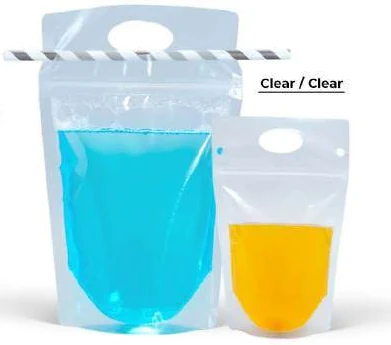
The catalogue includes spout pouches and beverage pouches with handles. These examples show different physical constructions; they are not interchangeable specifications. A fitted spout provides a controlled opening for dispensing. The reference range includes compact pouches and larger handled formats. Specify the product, fill volume, spout location and cap before developing the pouch shape; a corner spout and a top-centre spout require different layouts.
| Format reference | Material or construction to clarify | Details to include in the brief |
|---|---|---|
| Spout pouches | Flexible liquid-pack laminate with a fitted spout and cap; contact-layer and closure compatibility are reviewed for the formulation. | Fill volume and product viscosity; spout bore, position and cap. |
| Beverage pouches with handles | Transparent liquid-pack construction; contact layers and sealing requirements are reviewed for the beverage. | Beverage composition and fill volume; filling and final sealing method. |
Use the reference pictures to identify the base, side panels, window or opening that you mean. A picture cannot supply the missing dimensions or material layers. If a photograph shows a finish or closure you do not want, state that difference explicitly; otherwise a visual reference can introduce an unintended requirement.
Complete the record before requesting the next sample
- Attach instructions checked against the proposed physical sample. Identify the product or SKU and the date of the observation.
- Record the actual opening and transfer sequence. Keep confirmed information separate from proposed values and questions for the supplier.
- Add the actual fill weight or volume, the dimension convention, material proposal and intended closure. Include the number of designs and quantity per design when requesting a quotation.
- State which question the next drawing, sample or quotation must resolve. A change of size, closure or material should remain visible alongside the earlier reference.
This record makes the next conversation specific. It lets the design, purchasing and packing teams work from the same proposed item and shows which decision still needs evidence. Review the related product pages for format details, or prepare a custom packaging brief with the unresolved requirements.
Put the decision into practice
1. Collect approved content. Obtain authorised wording and claims before treating a design file as ready for printing.
2. Map the pack. Check the artwork against the current construction and actual use interfaces.
3. Review the proof scope. Ask each approver to sign only the content or reproduction questions within their responsibility.
4. Issue one release reference. Link the accepted artwork and drawing revisions before ordering printed pouches.
Provide Navkar Poly Print the approved content index and current dieline when requesting a non-food pouch print review.
Sources and scope.
These references support the technical discussion. Product photographs illustrate formats; the material, dimensions and suitability of the proposed pack are confirmed for each project.
- Cosmetics Europe: packaging information exchange
Primary industry guidance separates supplier information from the assessor responsibility; EU context does not establish Indian compliance.
- ZACROS: Flowpack NT tube refill pouch
Manufacturer relates its tube selection to contents and receiving-bottle opening; no claim Navkar makes this proprietary system.
- ISO 14021:2026 official public scope
Scope includes self-declared environmental claims in words/symbols/graphics; does not substantiate a particular claim or establish local compliance.
Let’s discuss your product.
Share your contents, dimensions, filling method, quantity and delivery destination. We’ll work through the proposed packaging specification with you.
Create a packaging brief