Review fine tea or tea powder using its actual finished form and the intended filling operation. Record dust, wall contact and access as observations, then have the technical owner assess their consequence. A fine product should not inherit a whole-leaf pack approval simply because both are sold as tea.
Identify the finished product accurately
Record the product reference, meaningful particle form, formulation or blend identity and target quantity. If the product includes other ingredients, identify the finished combination for review. Avoid using a broad marketing name as the only technical description.
The ICPE beverage chapter provides tea-specific context. It does not establish a structure or storage duration for an arbitrary powder or blend. Obtain actual product conditions and evidence requirements from the responsible technical owner before treating the pouch as approved.
Identify what the fine material actually is
Ask the producer to identify fine leaf, tea dust, powdered extract or another finished product through its current specification. These descriptions should come from the owner rather than a guess based on colour. A blend containing additional ingredients needs its own application identity.
Record representative variation relevant to the trial. A sample sifted for demonstration may differ from the normal material reaching the filler. State the sampling point, preparation and any approved treatment before observation.
Keep the quantity and use proposition in the same brief. A one-time transfer pack and a repeated-scooping family pack can share a product while needing different access observations. The physical form alone does not select the feature arrangement.
An illustrative product register could assign separate references to fine black tea and a formulated powdered beverage. Both may look like fine tea in a photograph, but they should not inherit each other's material, filling or storage conclusions. The supplier needs the actual finished-product information to propose a relevant sample.
Confirm the packing interface
State the established filling route and relevant equipment information. FLtècnics' application resource distinguishes premade-pouch and rollstock routes. Ask the packing owner which interface data controls the component being purchased.
Use representative finished product in an authorised trial. Observe empty presentation, product entry, settling and readiness for closing. Record where visible dust or product first approaches the marked working region. Do not prescribe machine settings or operational changes from a generic online guide.
Track visible movement through defined regions
Mark the mouth and intended closing region on the sample drawing. Observe the empty component, product entry, settling and state before closing. Record where visible fine material first appears, with sample and stage identities.
Distinguish loose material inside above the fill from material visibly crossing the intended closing area or lying on an external face. These observations can lead to different questions. A single dust label may obscure the actual location and consequence.
An illustrative sequence might show a clean empty mouth, visible airborne material during entry and particles high on one wall before closing. That narrows the investigation towards the filling sequence without proving a specific cause or performance consequence.
Choose observation points through the operating owner's authorised procedure. A packaging investigation should not require unapproved intervention around moving equipment. Where a stage cannot be observed, mark the interval unknown and design a suitable follow-up with the responsible team.

Use a fine-product stage record
| Stage | Observation | Question |
|---|---|---|
| Trial product | Actual identity and condition | Is the sample representative? |
| Product entry | Dust, wall contact or bridging | Where does the event begin? |
| Ready to close | Condition of the marked working region | What requires technical assessment? |
| First opening | Grip and resulting mouth | Is access clear? |
| Removal and reclosure | Pour or scoop path and feature contact | Does ordinary use remain practical? |
This original record keeps a visible event separate from a measured performance result. Write “not observed under this condition” where appropriate rather than making a universal no-dust claim.
Separate an observed particle from a closure conclusion
A visual observation can identify an event, but it does not quantify whole-pack integrity. Ask the technical owner which assessment addresses the actual concern. Retain the relevant method, specimen and result alongside the visible observation.
Do not combine appearance, sampled seal strength and leak evidence into one pass box. Each describes a different question. A visually clean region can still require technical evidence, while a visible external mark does not automatically establish a closure defect.
For an illustrative record, product across a marked closing region may trigger a defined closure assessment. Product on an unrelated external face may trigger a different presentation or hygiene review. The responsible team decides the consequence using the actual sample and application.
Keep the report scope clear when discussing a proposed correction. An observation that carryover appeared lower under one condition can justify further work. It should not become a universal no-dust claim or a storage-performance conclusion without relevant evidence.
Review the complete opening task
Give reviewers a complete unopened sample and ask them to perform normal product removal. Identify the actual scoop or receiving container where relevant. Record product approaching the zipper, film remaining above the opening and any difficulty reaching the intended quantity.
A fine product may behave differently during removal from during filling. Keep both tasks in the record. A clean industrial fill does not establish a convenient consumer pour, and a convenient opening does not establish technical closure performance or product suitability.
Observe removal through the actual opened mouth
Begin with the complete unopened pack and intended opening action. Identify the scoop or receiver used in the scenario. Observe the actual product path and any contact with the reclosure feature after removal.
Include an identified partly used state if repeat access is intended. A lower product level can change reach, grip and pouch shape. Keep these observations separate from the industrial filling record because the actions and geometry differ.
An illustrative comparison may find that candidate A pours neatly into a broad receiver, while candidate B better accommodates the intended scoop. The product owner should select the task the commercial proposition needs. Neither observation establishes a universally superior fine-tea pack.
Record any coaching or extra manipulation. If a demonstration succeeds only after an observer is shown a specific grip, the instruction may need design review. Do not silently turn specialist assistance into an assumed ordinary customer action.
Retain the sample-allocation plan where different assessments use different packs. A pouch opened for product examination cannot later represent an unopened first-use observation. Identifying the relevant samples beforehand prevents a missing reference from being replaced silently with a more convenient condition.
Compare changes against a defined problem
For an illustrative issue, a sample may close through the intended process but leave little space for a scoop after first opening. A geometry revision should be checked against that access task. It should not be described as resolving dust or storage performance unless separate evidence supports those outcomes.
If the product, material and filling procedure all change between trials, record the differences. The comparison concerns the complete proposal; it cannot isolate a single cause. Keep sample identities and the relevant observations available for supplier review.
Design the next comparison around the unresolved task
Write the event, proposed explanation and authorised comparison. Hold relevant inputs constant where practical and record every material difference. A changed product, pouch and process can support a whole-setup comparison but cannot isolate one cause.
Ask for samples that answer the next decision. Mouth access, feature location and final print review may require different sample stages. Label development samples so they do not acquire an implied production approval beyond their construction and purpose.
At release, pair the finished tea reference with drawing, construction, features and packing route. Link the technical conclusions and their actual scope. Intended departmental business review should remain distinguishable from completed technical approval.
For repeat orders, use that matched reference. If particle form, blend or operating route changes, have the relevant owners identify affected evidence. The resulting approval remains specific and useful instead of expanding through repeated use into a broad claim covering every tea powder.
Coffee valve: a practical specification example
A tea, coffee or spice buyer needs a material and closure brief as well as a visual style. A coffee valve is separate from a zipper; a paper-look surface is separate from the inner structure; a sachet is separate from a larger repeat-use pack. Start with the product form and use pattern, then compare the required opening and the printed panel that remains available.
For this decision, start with the coffee form and proposed valve location. The useful output is the valve, zipper and final top seal as separate specification items. Put that output beside the relevant quotation, drawing or sample rather than leaving it in a separate email. This is an illustrative decision exercise, not a report of a completed customer trial.
Product references to make the discussion concrete
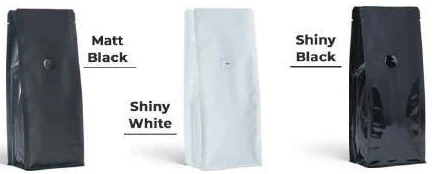
The catalogue includes side-gusset pouches and kraft paper pouches. These examples show different physical constructions; they are not interchangeable specifications. Folded sides expand as the pouch fills. This format has a different filled footprint from a bottom-gusset stand-up pouch, so specify the face width and opened side depth separately. A coffee-valve version can be discussed for the relevant product.
| Format reference | Material or construction to clarify | Details to include in the brief |
|---|---|---|
| Side-gusset pouches | Paper-look and opaque or foil-look laminates are illustrated; confirm the actual inner and outer layers for the contents. | Face width and side-gusset convention; filled height and headspace. |
| Kraft paper pouches | Kraft or paper outer with a product-specific inner construction; paper appearance does not establish a plastic-free composition. | Paper colour and surface preference; full layer structure and thickness. |
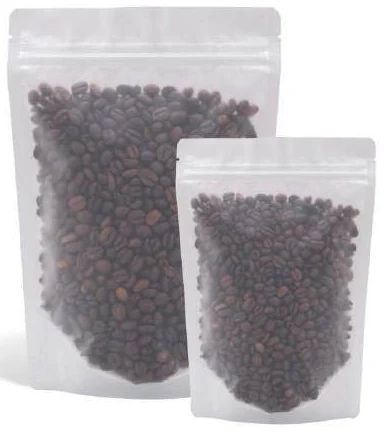
Use the reference pictures to identify the base, side panels, window or opening that you mean. A picture cannot supply the missing dimensions or material layers. If a photograph shows a finish or closure you do not want, state that difference explicitly; otherwise a visual reference can introduce an unintended requirement.
Complete the record before requesting the next sample
- Attach the valve, zipper and final top seal as separate specification items. Identify the product or SKU and the date of the observation.
- Record the coffee form and proposed valve location. Keep confirmed information separate from proposed values and questions for the supplier.
- Add the actual fill weight or volume, the dimension convention, material proposal and intended closure. Include the number of designs and quantity per design when requesting a quotation.
- State which question the next drawing, sample or quotation must resolve. A change of size, closure or material should remain visible alongside the earlier reference.
This record makes the next conversation specific. It lets the design, purchasing and packing teams work from the same proposed item and shows which decision still needs evidence. Review the related product pages for format details, or prepare a custom packaging brief with the unresolved requirements.
Release only the assessed scope
Link the product, quantity, drawing, feature arrangement and trial record. State which particle forms or blends were assessed. Have the responsible technical team review material, closure and storage evidence for the actual application, without extrapolating a short filling trial into a shelf-life claim.
Send Navkar Poly Print the fine-product stage record, finished tea sample and interface information. Request a proposal addressing the observed task and a sample route that lets the packing and product teams review the complete pack before release.
Sources and scope.
These references support the technical discussion. Product photographs illustrate formats; the material, dimensions and suitability of the proposed pack are confirmed for each project.
- ICPE: packaging of beverages including tea and coffee
Historical technical chapter differentiating tea and coffee concerns; no old numerical market shares or laminate recipes adopted.
- FLtècnics: spices, coffee and tea pouch machinery
Differentiates rollstock HFFS and premade-pouch HFS routes for these product categories.
Let’s discuss your product.
Share your contents, dimensions, filling method, quantity and delivery destination. We’ll work through the proposed packaging specification with you.
Create a packaging brief