Review cosmetic refill pouch transport performance on the actual packed configuration. Formula, pouch components, closing process and outer packing all need an identity, while the competent packaging team selects evaluation methods for the intended distribution route.
Define the unit being evaluated
Record whether the shipment contains single retail pouches, multipacks or cartons supplying a distributor. Include the complete pouch assembly, actual filled product reference, pack count, orientation and outer-pack specification. Empty pouch delivery to a filling plant is a different shipment from filled retail distribution.
Keep the intended channel visible: direct customer delivery, wholesale handling or another defined route. Obtain actual handover and receiving information from logistics. Avoid copying another project's transport test merely because the nominal pack quantity matches.
Match the evaluation to the intended channel
Identify whether the shipment is an individual parcel, a carton within a larger load or another actual configuration. Map the known handovers and receiving arrangement with logistics. The empty-component delivery and filled retail distribution remain separate systems.
ISTA's public procedure overview distinguishes screening from simulation purposes and distribution contexts. A competent team should select the relevant assessment for the intended decision. An informal observation shipment is not automatically a formal ISTA test or a certified system.
State whether the first work is exploratory learning, a comparison or acceptance under a specified plan. Keep methods and criteria under the accountable packaging team. Procurement contributes the actual channel and commercial requirements without inventing drop heights, durations or universal damage limits.
For an illustrative range, wholesale cartons and individual customer parcels can retain the same pouch while requiring separate shipping-unit records. Shared evidence can be considered through the relevant specialist's rationale rather than assumed from identical branding.
Connect transport review and product assessment
Cosmetics Europe separates information exchange from the product assessor's decision. A transport observation cannot settle formula compatibility, and a formula assessment does not establish carton performance. Give each question an owner and its own evidence link.
ZACROS describes product-specific choices in its refill portfolio. Keep the actual reviewed component identities in the transport file. A cap substitution or changed filled quantity should be visible to the team deciding whether further evaluation is needed.
Establish the actual filled baseline
Record formula, quantity, body, fitment, cap, final closing route and outer packing. Include counts, orientation and actual internal components. A transport result applies to that complete combination under its recorded exposure.
Assess relevant starting condition before dispatch using the method planned for receipt. Appearance, closure evidence and product outcomes answer different questions. A baseline photograph alone cannot cover every technical consequence that may be assessed later.
An illustrative baseline can show the approved loading orientation with packs identified by carton position. If the receiver later sees a different arrangement, retain both records and the known handling history. The difference directs investigation without proving when or why it occurred.
Keep product assessment linked but separate. A transport concern may prompt the relevant specialist to examine formula or pack effects, while a compatibility report does not establish outer-carton performance. Preserve each conclusion within its actual method and conditions.
Plan sample allocation where receiving observations lead to several assessments. A pouch opened for product examination cannot later represent an unopened closure or use task. The relevant owners should identify the required specimens and retain their history.
Also keep actual dispatch packing photographs with their date and configuration reference. They establish a known starting arrangement while leaving unrecorded transport events unknown. If a concern appears at receipt, the comparison can then distinguish documented starting condition from assumptions about the journey. This is more useful than reconstructing the load after unpacking or assigning every later difference to the carrier without a traceable baseline.

Record condition before unpacking changes it
Prepare a position map and photograph sequence for receiving. Note outer-carton condition first, then the original pouch arrangement and identified observations. Follow the product owner's approved procedures for suspect packs. Do not infer a cause from a photograph alone or describe the result as a universal no-leak guarantee.
Prepare receiving staff to preserve context
Agree the observation and photograph sequence before dispatch. Where practical, record outer condition before opening, then the original arrangement and identified pack findings. Use the product owner's procedures for suspect material and retain relevant custody information.
Give each carton and inspected position a reference. A layer-row-column convention can work without prescribing a particular carton layout. Link each pack examined to its original location and assembly identity.
For an illustrative observation, several concerns at a common contact location can justify a question about the arrangement. They do not isolate the cause. Compare dispatch images, receiving context and relevant production records before selecting a corrective proposal.
Record what was moved before inspection or could not be observed. A receiver may need to handle the shipment for legitimate reasons. Visible limits are more useful than reconstructing an assumed original arrangement and presenting it as fact. The record should show the evidence actually available.
Compare wholesale and parcel configurations
Take a hypothetical refill range sold both through a distributor and as single customer parcels. Create one shipping-unit row for each. Even if the pouch assembly is identical, record the different outer packing, pack count and handovers. The packaging specialist can decide whether common evidence is applicable or separate evaluation is required. If a parcel observation occurs, preserve its exact configuration rather than attributing it to every pouch in the wholesale carton. This approach helps the buyer compare a practical packing change with a component change using evidence scoped to the route that raised the question.
Keep route deviations and sample history visible
Record the actual dispatch and receipt, known handovers and departures from the plan. Do not insert assumed temperature, humidity or detailed handling where it was not measured or documented. A planned route and actual exposure are different records.
If a carton is opened, repacked or partly delivered, retain that event. The specialist can decide how it limits comparison and whether more work is needed. One changed condition does not automatically make every observation useless, but it must remain visible.
An illustrative follow-up may improve receiving documentation before changing any component. Another may compare a revised outer arrangement because the position map identifies a contact question. The action should follow the actual uncertainty rather than a general request for stronger pouches.
Keep retained samples identifiable under the authorised procedure. Discarding an unusual pack after one photograph can remove the opportunity for relevant technical examination. Record custody and investigation references so the result remains connected to the actual specimen.
Record the filled unit and receiving evidence
Use this original worksheet with your product and supplier team. Give each row a named owner and evidence reference; a blank answer remains an open decision.
| Record | What to enter and why |
|---|---|
| Filled assembly | Identify formula, pouch, fitment, cap, closing process and filled quantity under review. |
| Shipping configuration | Record pack count, orientation, outer packing and any retail or multipack components. |
| Distribution channel | Describe actual handovers and receiving conditions for each intended sales route. |
| Evaluation reference | Attach specialist-selected methods, sample plan and agreed acceptance criteria. |
| Receiving record | Map original positions, photographs, observations and sample custody before investigation. |
Release a scoped shipping configuration
State which assembly, outer packing and channel were evaluated, what the accountable team concluded and what remains open. A favourable observation on one route should not become a universal no-leak or damage guarantee.
If cap, quantity, formula, outer count or route changes, map the difference to relevant evidence. The specialist may retain some results and require further assessment elsewhere. Record the reason so future reviewers understand the accepted scope.
Before commercial release, reconcile the quoted component and outer-packing scope with the evaluated configuration. Technical acceptance and delivered economics need their own actual records. A useful sample does not establish freight cost, while a favourable quotation cannot settle an unresolved technical concern.
Retain the configuration, baseline, receiving map, reports and decision in the repeat-order file. The supplier receives a concrete current proposal, and procurement can recognise when a later request is within that scope or requires another channel-specific review.
Refill transport: a practical specification example
A refill concept starts with the formulation and dispensing route. The contents may contact the laminate, spout and cap, so each part belongs in the compatibility brief. A clear pouch shown with another product does not prove suitability for shampoo, oil or cleaner. Keep the intended pour, refill opening and transport handling visible while comparing the package with a bottle.
For this decision, start with the filled pack and dispatch arrangement. The useful output is the intended handling and leakage checks in the project brief. Put that output beside the relevant quotation, drawing or sample rather than leaving it in a separate email. This is an illustrative decision exercise, not a report of a completed customer trial.
Product references to make the discussion concrete
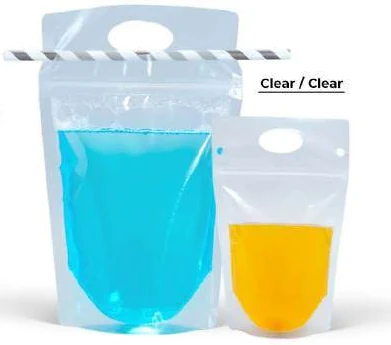
The catalogue includes spout pouches and beverage pouches with handles. These examples show different physical constructions; they are not interchangeable specifications. A fitted spout provides a controlled opening for dispensing. The reference range includes compact pouches and larger handled formats. Specify the product, fill volume, spout location and cap before developing the pouch shape; a corner spout and a top-centre spout require different layouts.
| Format reference | Material or construction to clarify | Details to include in the brief |
|---|---|---|
| Spout pouches | Flexible liquid-pack laminate with a fitted spout and cap; contact-layer and closure compatibility are reviewed for the formulation. | Fill volume and product viscosity; spout bore, position and cap. |
| Beverage pouches with handles | Transparent liquid-pack construction; contact layers and sealing requirements are reviewed for the beverage. | Beverage composition and fill volume; filling and final sealing method. |
Use the reference pictures to identify the base, side panels, window or opening that you mean. A picture cannot supply the missing dimensions or material layers. If a photograph shows a finish or closure you do not want, state that difference explicitly; otherwise a visual reference can introduce an unintended requirement.
Complete the record before requesting the next sample
- Attach the intended handling and leakage checks in the project brief. Identify the product or SKU and the date of the observation.
- Record the filled pack and dispatch arrangement. Keep confirmed information separate from proposed values and questions for the supplier.
- Add the actual fill weight or volume, the dimension convention, material proposal and intended closure. Include the number of designs and quantity per design when requesting a quotation.
- State which question the next drawing, sample or quotation must resolve. A change of size, closure or material should remain visible alongside the earlier reference.
This record makes the next conversation specific. It lets the design, purchasing and packing teams work from the same proposed item and shows which decision still needs evidence. Review the related product pages for format details, or prepare a custom packaging brief with the unresolved requirements.
Put the decision into practice
1. Map each channel. Separate wholesale and individual delivery configurations where their packing or handling differs.
2. Freeze the test identity. Record actual filled packs and outer packing before evaluation begins.
3. Collect ordered observations. Document outer and inner condition in sequence under the approved inspection procedure.
4. Review changes by scope. Ask specialists which component, quantity or route changes require additional evidence.
Send Navkar Poly Print your filled-pack identity and planned shipping configurations when arranging samples for cosmetic refill transport review.
Sources and scope.
These references support the technical discussion. Product photographs illustrate formats; the material, dimensions and suitability of the proposed pack are confirmed for each project.
- Cosmetics Europe: packaging information exchange
Primary industry guidance separates supplier information from the assessor responsibility; EU context does not establish Indian compliance.
- ZACROS: Flowpack NT tube refill pouch
Manufacturer relates its tube selection to contents and receiving-bottle opening; no claim Navkar makes this proprietary system.
- ISTA Test Procedures public overview
Official scope distinguishes assessment purposes and shipment contexts; no informal shipment claimed as formal test or certification.
Let’s discuss your product.
Share your contents, dimensions, filling method, quantity and delivery destination. We’ll work through the proposed packaging specification with you.
Create a packaging brief